COURSE · PART 1 · MODULE 1 · PAGE 1
What “Functional” Means and How FND Can Appear
This page explains what the word “functional” means, how FND can appear, how clinicians can identify it, and why the symptoms are real and involuntary.
“Functional disorders are conditions whose origin arises primarily from a disorder of nervous system functioning rather than clearly identifiable pathophysiological disease… It causes considerable physical disability and distress…” - Professor Jon Stone, neurologist (BMJ 2020;371:m3745)
“FND is currently defined as a ‘clinical syndrome with genuinely experienced neurological symptoms which are distressing or impairing, and show dysfunction of the nervous system with variability in performance within a task or between task’” -Functional neurological disorder: Practical management. Barbara A. Dworetzky, Gaston Baslet
Figure 1
The word ‘functional’ tells us that the way the nervous system transmits information throughout the brain and body is no longer working correctly. This affects actions like movement, sensation, attention and awareness. [2][9]
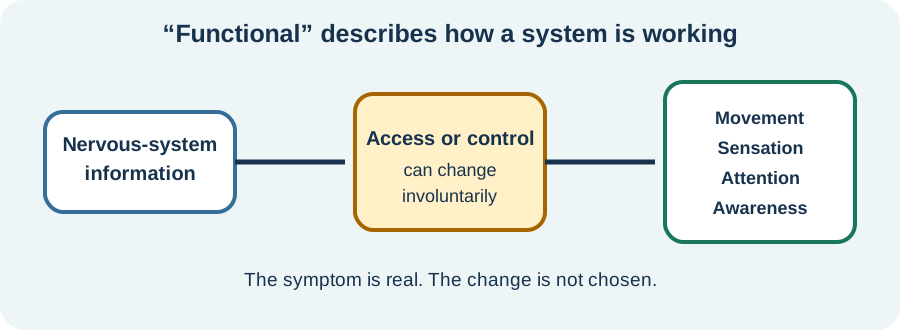
Illustration: “functional” describes how the system is working. The symptom is real, and the change is not chosen.
Quick Fact
Functional Neurological Disorder (FND) and Functional Seizures (FS) are known by other names.
- PNES (Psychogenic non-epileptic seizures), Pseudoseizure, Dissociative Attack
- Conversion Disorder, Functional Cognitive Disorder (a subtype), Functional Neurological Disorders (FNDs)
- Functional Movement Disorder (FMD) (a subtype) However, Conversion Disorder and PNES are going out of use. Also, the term ‘pseudoseizures’ is offensive to many sufferers. [2][4][9]
For the Person With FND
For Family, Friends, and Other Supporters
For Clinicians and the Care Team
Research and Sources
—
For the Person With FND
If you have been recently diagnosed, you might be wondering if your symptoms are even FND or not. Likely, tests were done to determine you didn’t have some other medical issue or a psychological issue. It’s also very likely that you didn’t undergo any tests to prove you do have Functional Neurological Disorder. The reason is that education about FND is limited and many doctors have not been taught what to do when they encounter someone who displays all these ‘bizarre’ symptoms. [1]
The biggest question everyone has is, “Is FND a psychological disorder??” Emphatically, No!
Researchers have found differences in brain structure, activity or chemistry when groups of people with FND are compared with other groups. These findings are still being studied. They cannot yet diagnose FND in one person or tell us whether a difference caused FND or developed afterward. The chemistry study cited here involved young people with functional seizures; it does not speak for everyone with FND. The important thing to know is Your symptoms ARE REAL and they are not faked or imaginary. [2][3][5][6][9]
So what does functional actually mean? In short it describes how your nervous system is processing motor and sensory information. In FND there is a problem with how our brain and nervous system interact. FND belongs to a wider family of overlapping functional disorders that can include fibromyalgia, chronic fatigue and irritable bowel syndrome. [1][3][13]
How did I get Functional Neurological Disorder? Researchers have found that FND can begin at any age. It is diagnosed more often in women. One website explains that the triggering event could be a physical injury, migraine, trauma, or even a fainting experience! [1][2][7][9]
Can FND be cured? Is it permanent? There is no cure for FND but many have found improvements in their condition that can be considered ‘remission’ of the disease. Many believe that understanding your disease is the key first step in making improvements. [1][3][8]
Is there a way to diagnose FND? Yes! There are specific tests and observations that a neurologist can use during an examination to identify signs of FND. Your diagnosis should never be “All your tests were normal.” [3]
How do I improve my condition? This is what we hope to accomplish in this educational course. The lessons are each designed to inform you and show what you can do now at home to make positive changes in your disease.
What are the symptoms of FND? A person can present with one or more symptoms. Some symptoms are not considered to be FND but often appear alongside FND. [2][3][9] Here’s a list of common FND symptoms:
- weakness in an arm or leg
- functional ‘seizures’
- reduced sensation in parts of the body
- involuntary movements like tremor or jerks and spasms
- difficulty walking
- memory and concentration issues
- speech and swallowing problems
- dizziness (a type associated with FND)
- falls to the ground
- overactive bladder and other bowel and bladder problems
- visual blurring, light sensitivity
- sound sensitivity
- functional motor and vocal/phonic tic-like symptoms — see also the movement and tics lesson
And these are problems that are commonly experienced among sufferers but aren’t necessarily part of FND (we’ll talk about that later and why researchers differ in what they consider FND and what they consider “comorbid”): [3][9]
- Not feeling like quite yourself, ‘spaced out’
- fatigue
- pain
- health anxiety
- irritable bowel syndrome
- headache [or migraine, though most term a long lasting migraine as ‘chronic headache’]
- sleep problems
- anxiety, depression, panic
- sometimes chest pain! FND has been known to mimic both stroke and epilepsy. [3]
For an introduction to what FND is, I only want to mention that FND is very episodic. Many experience bad days, weeks, and sometimes months followed by better days where their symptoms aren’t active. One of the best things you can do now besides continue your education about this very debilitating disease is to learn how to communicate with your doctors and those acting as caregivers in your life if your symptoms require that. [9]
If you want to see how your symptoms fit into FND one of my favourite resources is NeuroSymptoms.org. The author is one of the lead researchers of FND and they have put together a symptom tracker as well as a fairly complete list of each of the symptoms and how they are diagnosed and even a little about what you can do now about them. There are some videos as well which will let you see how others experience these symptoms.
If you haven’t already asked these of the diagnosing doctor, here’s a few good questions you might ask
- “Which of my symptoms have you identified as functional?”
- “What positive signs support that diagnosis?”
- “What did my tests rule in or rule out?”
- “Could another condition also be present?”
Another useful thing to do is put into your own words what FND is and how to explain to your family and friends.
Crosswords
- What is FND? (normal) (easy) (answer key)
For the Person With FND
For Family, Friends, and Other Supporters
For Clinicians and the Care Team
Research and Sources
—
For Family, Friends, and Other Supporters
Functional Neurological Disorder is a very disabling disease and it can vary in how many symptoms or how sensitive those symptoms are. This used to be considered a psychiatric diagnosis called ‘conversion disorder,’ however, that term and the idea that these symptoms must be of a psychogenic (from the mind or emotions) or psychiatric cause is false. In fact, recent findings have shown that diagnosis of FND does not need a psychological precipitating factor. [2][4][9]
Support the person you are showing care to often involves assuring the person that their symptoms are real and not faked. They did not cause their disease. It’s also very important to understand that not every new symptom is FND. All new symptoms should be looked at by a doctor because many serious medical issues look like an FND symptom. [3][9]
- “PMD [functional movement disorder] patients reported similar Physical Health QOL [quality of life] to PD [Parkinson’s disease] patients … but worse mental health QOL [quality of life].”
- “Patients with [functional weakness] are as disabled as patients with weakness of similar duration due to neurological disease.”
- “Compared to epilepsy, people with psychogenic non-epileptic seizures [now usually called functional seizures] have consistently reported worse HRQoL [health-related quality of life].”
Figure 2
For the Person With FND
For Family, Friends, and Other Supporters
For Clinicians and the Care Team
Research and Sources
—
For Clinicians and the Care Team
A 2022 paper titled, “Functional Neurological Disorder: new subtypes and shared mechanisms” makes three statements worth repeating here verbatim:
- “The pathophysiology of functional neurological disorder includes overactivity of the limbic system, the development of an internal symptom model as part of a predictive coding framework, and dysfunction of brain networks that gives movement the sense of voluntariness.”
- “A new approach to the positive diagnosis of this disorder focuses on recognisable patterns of genuinely experienced symptoms and signs that show variability within the same task and between different tasks over time.”
- “Psychological stressors are common risk factors for functional neurological disorder, but are often absent.”
- “Four entities—functional seizures, functional movement disorders, persistent perceptual postural dizziness, and functional cognitive disorder—show similarities in aetiology and pathophysiology and are variants of a disorder at the interface between neurology and psychiatry.”
Clearly, this is a disease that is based on real dysfunction with a variety of causes that does not necessarily require a psychological stress. It’s subtypes are well recognized and importantly, diagnosis can be made using positive clinical features. For a complete list of those diagnosis techniques, see our reference section.
Here are some resources:
- FND Hope - Medical Professionals
- neurosymptoms.org — Symptoms — Created by neurologist Professor Jon Stone, with contributions from other health professionals. Many symptom pages explain the positive clinical signs that clinicians may use to support a diagnosis, how the symptom may differ from similar symptoms caused by other conditions, and treatment or self-management approaches that may help.
A useful explanation should identify which symptoms have been diagnosed as functional, demonstrate the clinical features supporting that conclusion and explain what investigations have ruled in or ruled out. Patients should be told explicitly that their symptoms are real, involuntary and potentially treatable. Statements such as “all your tests were normal” or “nothing is wrong” do not adequately communicate a positive diagnosis and may reinforce distrust or diagnostic uncertainty.
I was diagnosed just over a month ago. I met with my neurologist, who was very nice and thorough, but after he gave me the diagnosis, he told me to get into talk therapy and physical therapy. Then he wrote a website down for me to check out and that was that. There was no discussion explaining the condition and reasoning for the two therapies. — (Lived experience; Reddit user u/Im_not_sure_042)
“for a brief time we were increasingly scared that I had a physical brain injury and I was deteriorating rapidly. I wound up in the ER and a consulting neurologist was able to clearly track and analyze the exact patterns (and lack thereof) of my involuntary movements, she performed a series of examinations + an hour of observation, conversation, distracting me, etc. I was surprised by the diagnosis, but just the information alone that I wasn’t dying was enormously reassuring. I woke up the next day with my symptoms WAY less pronounced and disruptive… I’m extremely grateful for the information and education on FND, because the distraction and redirection techniques have been very helpful to getting me back on my feet (literally).” — (Lived experience; Reddit user u/mackydraw)
This free online course is contributed to by those with lived experience in Functional Neurological Disorder [currently, the official term provided by the DSM-V-tr] with the intent of bringing as much of the current research together in one place. The content for medical practitioners is centered around ways of being helpful to your patient both in understanding what their disease is and what they can do to improve a specific symptom or to support them when a symptom is likely not going to improve. We invite you to visit this section in each page of this course while also reading the content for the patient where most of the discussion will take place. Following this section is where you’ll find the research behind that content. If you disagree about how a paper was interpreted, we are always open to hearing from you.
For the Person With FND
For Family, Friends, and Other Supporters
For Clinicians and the Care Team
Research and Sources
—
Research and Sources
Three focused quotations
- “It causes considerable physical disability and distress.” [1]
- “The diagnosis of FND [functional neurological disorder] should rest on clear positive evidence.” [3]
- “Psychological stressors are important risk factors but are neither necessary nor sufficient for the diagnosis.” [1]
Citation table
| Citation | Figure | Full citation |
|---|---|---|
| [1] | Figure 1 | Stone J, Burton C, Carson A. Recognising and explaining functional neurological disorder. BMJ. 2020;371:m3745. FND-CIT-0043. https://doi.org/10.1136/bmj.m3745 |
| [2] | Figure 1 | Dworetzky BA, Baslet G. Functional neurological disorder: Practical management. Neurotherapeutics. 2025;22(4):e00612. FND-CIT-0013. https://doi.org/10.1016/j.neurot.2025.e00612 |
| [3] | — | Bennett K, Diamond C, Hoeritzauer I, Gardiner P, McWhirter L, Carson A, Stone J. A practical review of functional neurological disorder (FND) for the general physician. Clinical Medicine. 2021;21(1):28–36. FND-CIT-0001. https://doi.org/10.7861/clinmed.2020-0987 |
| [4] | — | Espay AJ, Aybek S, Carson A, et al. Current concepts in diagnosis and treatment of functional neurological disorders. JAMA Neurology. 2018;75(9):1132–1141. FND-CIT-0002. https://doi.org/10.1001/jamaneurol.2018.1264 |
| [5] | — | Bègue I, Adams C, Stone J, Perez DL. Structural alterations in functional neurological disorder and related conditions: a software and hardware problem? NeuroImage: Clinical. 2019;22:101798. FND-CIT-0004. https://doi.org/10.1016/j.nicl.2019.101798 |
| [6] | — | Charney M, Foster S, Shukla V, et al. Neurometabolic alterations in children and adolescents with functional neurological disorder. NeuroImage: Clinical. 2024;41:103557. FND-CIT-0044. https://doi.org/10.1016/j.nicl.2023.103557 |
| [7] | — | Lidstone SC, Costa-Parke M, Robinson EJ, Ercoli T, Stone J; FMD GAP Study Group. Functional movement disorder gender, age and phenotype study: a systematic review and individual patient meta-analysis of 4905 cases. Journal of Neurology, Neurosurgery & Psychiatry. 2022;93(6):609–616. FND-CIT-0045. https://doi.org/10.1136/jnnp-2021-328462 |
| [8] | — | Gelauff J, Stone J, Edwards M, Carson A. The prognosis of functional (psychogenic) motor symptoms: a systematic review. Journal of Neurology, Neurosurgery & Psychiatry. 2014;85(2):220–226. FND-CIT-0007. https://doi.org/10.1136/jnnp-2013-305321 |
| [9] | — | Hallett M, Aybek S, Dworetzky BA, McWhirter L, Staab JP, Stone J. Functional neurological disorder: new subtypes and shared mechanisms. The Lancet Neurology. 2022;21(6):537–550. FND-CIT-0003. https://doi.org/10.1016/S1474-4422(21)00422-1 |
| [10] | Figure 2 | Anderson KE, Gruber-Baldini AL, Vaughan CG, Reich SG, Fishman PS, Weiner WJ, Shulman LM. Impact of psychogenic movement disorders versus Parkinson’s on disability, quality of life, and psychopathology. Movement Disorders. 2007;22(15):2204–2209. FND-CIT-0046. https://doi.org/10.1002/mds.21687 |
| [11] | Figure 2 | Stone J, Warlow C, Sharpe M. The symptom of functional weakness: a controlled study of 107 patients. Brain. 2010;133(5):1537–1551. FND-CIT-0047. https://doi.org/10.1093/brain/awq068 |
| [12] | Figure 2 | Jones B, Reuber M, Norman P. Correlates of health-related quality of life in adults with psychogenic nonepileptic seizures: a systematic review. Epilepsia. 2016;57(2):171–181. FND-CIT-0048. https://doi.org/10.1111/epi.13268 |
| [13] | — | Stone J, Coebergh J, Khoja L, et al. Migraine and functional neurological disorder (FND)—a review of comorbidity and potential overlap. Brain Communications. 2025;7(4):fcaf288. FND-CIT-0049. https://doi.org/10.1093/braincomms/fcaf288 |