COURSE · PART 1 · MODULE 1 · PAGE 2
The Biopsychosocial Model and Misconceptions
This page explains the biopsychosocial model in simple terms, what it does and does not mean for FND, and how biological, psychological, and social factors can guide individual care and support.
For the Person With FND
For Family, Friends, and Other Supporters
For Clinicians and the Care Team
Research and Sources
—
For the Person With FND
FND is a neurological disease that can be understood through a biopsychosocial model. What does this mean? [1][2][3]
When we talk about the biopsychosocial model, it is in relation to how your symptoms are affected by, well, all aspects of your life and health, really. [1][3]
- The ‘bio’ part refers to your biology; your current health issues and how your nervous system responds to things. It also includes what we talked about in module 1, that the way your brain talks to the rest of your body and nervous system is disrupted.
- The ‘psycho’ or ‘psychological’ part of the word helps us to see that life stresses both past and present can strongly affect your symptoms. The psychology we are talking about here also includes how you cope with those stresses and your emotional self.
- Finally, the ‘social’ aspect of this not only includes your culture but also your access to health care and the family and social support you have.
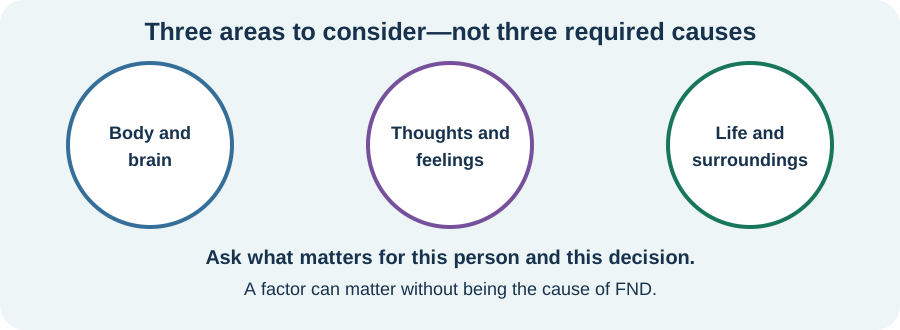
Illustration: the three areas help organize an individual picture. They are not three required causes.
Let’s talk about this in a way that is more familiar: the common headache. A headache can be triggered by lots of things: sore muscles, stress, an injury to your head. Likewise, FND can be triggered by a health issue, a specific injury or even a very stressful situation. When you have a headache, those same things can make it feel worse. [1][3]
With FND your symptoms can flare or become worse temporarily because of a stressful situation including a health situation. Like a headache, there are some medications that can make your symptoms less and, also like a headache, you might find meditation and relaxation a way to lower your symptoms as well. [1][4]
However, FND is not a headache. In fact, quality of life can be very poor. But, both your symptoms and that quality of life can improve. [1][6]
Questions
• How do you think building a good support group around you can improve the way you cope with your symptoms?
• How do you think stress affects your symptoms? Have you noticed when your symptoms become worse?
What can the person safely try at home?
If you are able, journal or at least begin to write down when your symptoms get worse. Did something happen just before? Taking note of this is a large part of improving your symptoms. Here’s an idea: on the piece of paper make three columns. Each column has one of these headings: “body and brain”, “thoughts and feelings”, “life and surroundings”. Each time you find your symptoms worse, try to put something into each column.
Don’t worry if you can’t journal! Personally, my functional symptoms prevent me from remembering and I found journaling nearly impossible. However, I have been successful, over time, in understanding what triggers my symptoms to get worse.
Crosswords
- Biopsychosocial What? (normal) (easy) (answer key)
For the Person With FND
For Family, Friends, and Other Supporters
For Clinicians and the Care Team
Research and Sources
—
For Family, Friends, and Other Supporters
As described earlier on this page, the ‘biopsychosocial model’ for FND talks about how those areas of life affect the sufferer’s symptoms - both in positive ways and in negative ways. As a support person, we are not able to change the biology of the person. Their symptoms, regardless of how strange they can sometimes look, are just what a disrupted communication between brain and nervous system looks like. There is currently no medication to treat FND. A key way to help is assisting with personal care, when needed, and access to healthcare
That leaves just two areas: the psycho and the social. If there are other psychological stresses like a past or present trauma or a disorder that they have been diagnosed with it might be good to encourage them to carry on therapy. That said, I want to express a lot of caution: most therapists don’t understand FND and even when some say they do, I personally have found that their concept isn’t up to date. In some parts of the world there are great FND clinics. It is probably not a good idea to push anyone with FND into therapy or a particular therapist.
For the first few years, it was too triggering for me to attempt therapy but later, when I was ready, it proved helpful to work with some of my past traumas. The biggest thing I got from therapy was a better attitude towards my symptoms. — (Lived experience)
You are one of the sufferer’s social group. You can help the person to try the various exercises that are described online and in this course and you can encourage them especially as they grieve their new disability. And, symptoms come and go and new ones appear. Helping the person to not be too anxious about their health is very helpful, but because new symptoms often look like other medical or mental problems, it’s best to encourage the person to have these investigated. [5]
I also found it unhelpful when my support person’s optimism was misplaced; all the many positive things they were doing for me made my life more comfortable, easier to adapt to, and made me feel safe. But, no matter what they did, FND was not going to go away. Our life had permanently changed. — (Lived experience)
For the Person With FND
For Family, Friends, and Other Supporters
For Clinicians and the Care Team
Research and Sources
—
For Clinicians and the Care Team
In the previous article, it was shown that researchers have established that Functional Neurological Disorder sits “at the interface between neurology and psychiatry”. [1] What is the biopsychosocial model?
- What it is: The biopsychosocial model is a way of looking at how the body and brain, thoughts and emotions, and a person’s life and surroundings may affect their health and recovery.
- What it isn’t: It does not mean that FND is caused by thoughts, stress, trauma or mental illness. It does not replace a positive neurological diagnosis, and all three areas do not have to affect every person. [1][2][3]
People with functional seizures have an increased risk of premature death. In one study, among patients who died before age 50, 20% of those deaths were attributed to suicide.
Figure 1
The biopsychosocial model is a way of guiding individual support by looking at all the factors that influence the person’s symptoms: psychological support when appropriate and assistance with education and employment are two examples. Here are some of the common comorbidities in relation to the ‘biological’ and ‘psychological’ aspects and many of the common problems facing sufferers of FND. [1][3][9]
| Area | Common accompanying problems |
|---|---|
| Biological/physical | Fatigue; memory and concentration problems; chronic pain; migraine or headache; poor sleep; irritable bowel syndrome; fibromyalgia; complex regional pain syndrome; and sometimes another neurological condition such as epilepsy. [6][7] |
| Psychological | Anxiety, panic disorder, depression, post-traumatic stress disorder and dissociative symptoms or disorders. These should be treated when present, but they are not required for FND and should not be assumed to have caused it. [2][6] |
| Social | Loss of employment or education; financial pressure; reduced independence; isolation; strained relationships; caregiver burden; stigma; unsuitable housing or transportation; and difficulty accessing knowledgeable healthcare or rehabilitation. [6][9] |
One of the key complaints on reddit among sufferers of FND is how after diagnosis they are given a link to a website and little further care is afforded them. Clearly, however, good communication leads to appropriately triaging the patient. For instance, this page on neurosymptoms.org, clearly show which symptoms are part of FND and which are likely not to be.
Symptoms not associated with FND need to be investigated both at diagnosis and during the course of the disease. [5][8]
“When I developed bowel and urinary problems, an MRI appeared to show spinal-cord compression at T10–11, and surgery was being considered. However, the neurosurgeon examined me first and found that the examination did not match the MRI. A second MRI confirmed there was no herniation—the first image was misleading.
I had previously experienced genuine bowel and bladder problems from a T6–7 disc herniation, so the new symptoms could not simply be dismissed as FND. My experience shows why new symptoms must be investigated, but also why imaging should be interpreted alongside the clinical examination before deciding on treatment.” — (Lived experience)
Investigating symptoms and referring your patient to other resources including social workers is good health care. [1][9]
For the Person With FND
For Family, Friends, and Other Supporters
For Clinicians and the Care Team
Research and Sources
—
Research and Sources
Three focused quotations
- “Psychological stressors are common risk factors for functional neurological disorder, but are often absent.” [1]
- “Most respondents reported that FND had multiple causes, including physical and psychological.” [6]
- “A change in seizure frequency may not translate to participation in life roles.” [9]
Citation table
| Citation | Figure | Full citation |
|---|---|---|
| [1] | — | Hallett M, Aybek S, Dworetzky BA, McWhirter L, Staab JP, Stone J. Functional neurological disorder: new subtypes and shared mechanisms. The Lancet Neurology. 2022;21(6):537–550. FND-CIT-0003. https://doi.org/10.1016/S1474-4422(21)00422-1 |
| [2] | — | Espay AJ, Aybek S, Carson A, et al. Current concepts in diagnosis and treatment of functional neurological disorders. JAMA Neurology. 2018;75(9):1132–1141. FND-CIT-0002. https://doi.org/10.1001/jamaneurol.2018.1264 |
| [3] | — | Pick S, Goldstein LH, Perez DL, Nicholson TR. Emotional processing in functional neurological disorder: a review, biopsychosocial model and research agenda. Journal of Neurology, Neurosurgery & Psychiatry. 2019;90(6):704–711. FND-CIT-0005. https://doi.org/10.1136/jnnp-2018-319201 |
| [4] | — | Dworetzky BA, Baslet G. Functional neurological disorder: Practical management. Neurotherapeutics. 2025;22(4):e00612. FND-CIT-0013. https://doi.org/10.1016/j.neurot.2025.e00612 |
| [5] | — | Bennett K, Diamond C, Hoeritzauer I, Gardiner P, McWhirter L, Carson A, Stone J. A practical review of functional neurological disorder (FND) for the general physician. Clinical Medicine. 2021;21(1):28–36. FND-CIT-0001. https://doi.org/10.7861/clinmed.2020-0987 |
| [6] | — | Butler M, Shipston-Sharman O, Seynaeve M, et al. International online survey of 1048 individuals with functional neurological disorder. European Journal of Neurology. 2021;28(11):3591–3602. FND-CIT-0014. https://doi.org/10.1111/ene.15018 |
| [7] | — | Steinruecke M, Mason I, Keen M, McWhirter L, Carson AJ, Stone J, Hoeritzauer I. Pain and functional neurological disorder: a systematic review and meta-analysis. Journal of Neurology, Neurosurgery & Psychiatry. 2024;95(9):874–885. FND-CIT-0015. https://doi.org/10.1136/jnnp-2023-332810 |
| [8] | — | Hoeritzauer I, Pronin S, Carson A, Statham P, Demetriades AK, Stone J. The clinical features and outcome of scan-negative and scan-positive cases in suspected cauda equina syndrome: a retrospective study of 276 patients. Journal of Neurology. 2018;265(12):2916–2926. FND-CIT-0016. https://doi.org/10.1007/s00415-018-9078-2 |
| [9] | — | Sekine ER, Kanaan RA, McMillan J, Oxford S, Iles RA. Biopsychosocial prognostic indicators in Functional Neurological Disorder: a systematic review. Journal of Psychosomatic Research. 2025;195:112201. FND-CIT-0017. https://doi.org/10.1016/j.jpsychores.2025.112201 |
| [10] | Figure 1 | Nightscales R, McCartney L, Auvrez C, et al. Mortality in patients with psychogenic nonepileptic seizures. Neurology. 2020;95(6):e643–e652. FND-CIT-0050. https://doi.org/10.1212/WNL.0000000000009855 |