COURSE · PART 1 · MODULE 3 · PAGE 1
Causes, Risk Factors, Triggers, and Maintaining Factors
People often use words such as **cause**, **trigger** and **risk factor** as though they mean the same thing. They do not. Keeping them separate can make FND explanations more honest and can stop a possibility found in a group of people from being treated as a proven explanation for one person. (*citations* [1](#citation-1), [2](#citation-2), [3](#citation-3))
For the Person With FND
For Family, Friends, and Other Supporters
For Clinicians and the Care Team
Research and Sources
—
For the Person With FND
There is not one proven cause or mechanism that explains every person’s FND. Some people remember a clear event near the beginning of their symptoms. Others remember several possible influences, and some cannot identify a beginning at all. None of these experiences makes the diagnosis more or less real. [2][3][4]
What do these words mean?
| Word | Plain-language meaning |
|---|---|
| Association | Two things are found together more often than expected. This does not show that one caused the other. |
| Vulnerability | Something that may leave a person more susceptible under certain conditions. It does not mean weakness or fault. |
| Risk factor | Something linked with a greater chance of an outcome in a group. It may not explain why one individual became ill. |
| Trigger | Something that happens shortly before symptoms begin or flare. Clinicians may also call this a precipitating factor. |
| Mechanism | A proposed or demonstrated process through which a symptom happens. A mechanism describes how, not necessarily why it began. |
| Maintaining factor | Something that may help symptoms continue or become harder to change after they have begun. This is also called a perpetuating factor. |
| Cause | Something shown to produce an outcome. An event happening first, or a treatment helping later, does not by itself prove cause. |
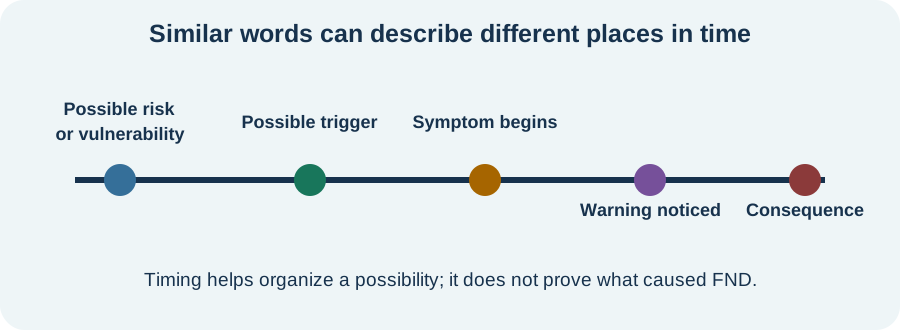
Illustration: timing helps organize possibilities. It does not prove what caused FND.
One factor can have different roles in different people. Migraine might occur near the beginning of FND for one person, exist as a separate diagnosis for another, or have no known connection for someone else. [6]
The beginning and the present may be different
The event that came before FND may not be what affects symptoms now. For example, symptoms might begin during an illness or after an injury, but later become more troublesome when pain, poor sleep, sensory surroundings or the effort of managing symptoms reduces the person’s available capacity. This example describes a possible pattern; it does not prove that illness caused the FND or that low capacity explains every flare. [3][5][6]
Researchers and clinicians have considered physical illness, injury, pain, migraine, sleep disruption, medication effects, fatigue, exhaustion, stress, trauma, psychiatric conditions and dissociation. Any of these may matter for some people, but none is required in every person. In particular, trauma, stress and mental illness are not requirements for an FND diagnosis. [1][2][3][5][6]
Attention, expectations, past learning and automatic nervous-system processes are also part of some proposed explanations. Automatic is important: it means these processes can occur without deliberate choice. It does not mean that a person is imagining or consciously producing a symptom. [2][3]
What is neuroplasticity?
Neuroplasticity means that the nervous system can learn and change. This is one reason rehabilitation may try to make a useful movement or response easier to access and repeat.
Neuroplasticity is not a promise that every symptom will improve. It is also not proof that the nervous system simply “learned FND” or that a person can unlearn symptoms through effort. A treatment can be useful even when the theory offered for why it works is incomplete. [2][3]
What can this uncertainty feel like?
One person may say, “My symptoms began after an infection.” Another may remember an injury, migraine or frightening event. Someone else may say, “Nothing unusual happened; the symptoms simply started.” These are descriptions of experience, not automatically proof of cause.
Conflicting explanations can be frustrating. One clinician may emphasize stress, another a physical event, and another attention or prediction. A useful explanation should say what is known about your history, what is only possible, and what remains unknown. It should not search for hidden trauma or assign blame simply because a complete explanation is unavailable.
Community experiences for review
These are two candidate lived-experience quotations from the project’s community collection. Together they show why an identifiable pattern should not be required: one person noticed a possible influence, while another described no clear beginning.
Option 1 — a possible sensory influence
“My FND symptoms, especially risk of seizures, get worse around sensory overload.”
— This writer described autism, sensory-processing difficulty and a personal relationship between overload and symptom flares. Read the public source.
Option 2 — no identifiable beginning
“Since half a year I have a resting tremor in my hands. This tremor just came out of nowhere.”
— This writer reported substantial improvement in earlier symptoms but the later appearance of a new tremor. Read the public source.
These accounts describe personal timing and patterns; neither proves a cause or mechanism.
Questions
When you think about how your FND began, what do you know happened, and what has only been suggested as an explanation?
Are the things that seem to affect your symptoms now the same as what was happening when the symptoms first began?
What can you safely try at home?
Choose one possible influence—not your whole life story—and place what you know under four headings:
- Known fact: what was observed, diagnosed or clearly recorded.
- Plausible contributor: something that might matter but has not been proved.
- Unanswered question: something that may need discussion or assessment.
- Unsupported assumption: a conclusion for which you have not been given evidence.
A lower-demand version is to finish one sentence: “I know __ happened, but I do not yet know whether it caused or affected __.”
Stop if the exercise sharply increases distress, symptoms or pressure to uncover a particular memory. Ask for professional help when the question involves a new or changing symptom, medication, another medical condition, safety, or trauma that you want help addressing. This exercise is a way to organize uncertainty, not to diagnose a cause.
For the Person With FND
For Family, Friends, and Other Supporters
For Clinicians and the Care Team
Research and Sources
—
For Family, Friends, and Other Supporters
The person may want to understand why FND happened, but they may not have a single answer. Listen to what they know and what they are unsure about without enforcing your preferred theory.
Avoid searching for hidden trauma, treating stress as the automatic answer, or suggesting that a continuing symptom must be maintained by the person’s thoughts or behaviour. Even a factor that genuinely affects symptoms is not proof of blame or conscious control.
Practical support can focus on the present: what makes an activity harder, what reduces demand, what safety plan is needed and what the person wants help with. Ask before recording patterns or offering observations. Support should not turn daily life into an examination or make you the person’s clinician or supervisor.
If a symptom is new or substantially different, help the person obtain appropriate assessment instead of deciding that a familiar trigger or an existing FND diagnosis explains it.
For the Person With FND
For Family, Friends, and Other Supporters
For Clinicians and the Care Team
Research and Sources
—
For Clinicians and the Care Team
Research quotations for review
These quotations are offered as two possible evidence anchors for this section. The first comes from a broad clinical review; the second comes from a large online survey and must be read with its selection and response-bias limitation.
Option 1 — Hallett et al., 2022
“Psychological stressors are common risk factors but may be absent.”
Option 2 — Butler et al., 2021
“Most respondents reported that FND had multiple causes, including physical and psychological.”
Figure 1 — Research quotations offered for editorial selection. [2][4]
Help the patient separate evidence from formulation
State which parts of the explanation are supported by the patient’s history and positive clinical findings, which are plausible contributors, and which are proposed mechanisms. A group-level association cannot establish the cause of one person’s FND. [1][2][3]
Technical research terms also need care. A risk marker predicts an outcome without necessarily causing it. A mediator is a possible pathway between an influence and an outcome. A moderator changes the strength or direction of a relationship. These distinctions can be useful in research without providing an individual causal explanation.
Assess factors for a defined reason
History, observation and examination, targeted testing, and specialist input may identify diagnoses, risks or treatable contributors. Migraine, epilepsy, sleep disorders, pain, medication effects, injury, psychiatric conditions and autonomic disorders may be triggers, comorbidities, alternative explanations or unrelated findings, depending on the person. [4][5][6][7]
Explain the limitations of each assessment. Cross-sectional associations may reflect reverse causation; small or heterogeneous samples may not generalize; an interesting group biomarker is not automatically a diagnostic test; and a result that has not replicated should not be presented as settled. [3][4][5][7]
Use a theory only as far as it helps
A formulation may guide an individualized rehabilitation, psychological, medical, safety or support plan. The plan should still make sense if one proposed mechanism is later revised. Improvement with attention strategies, physiotherapy, psychotherapy, treatment of migraine or another intervention does not prove what originally caused the FND. [1][2][3][6]
Do not insist on trauma work, exposure, exercise or another theory when it is unwanted, individually irrelevant or causing harm. Continue symptom relief, safety planning, accessibility, participation, supporter guidance and reassessment even when improvement is limited or a cause remains unknown.
Adopting an FND mechanism must not prevent investigation of new, severe or substantially changed symptoms.
For the Person With FND
For Family, Friends, and Other Supporters
For Clinicians and the Care Team
Research and Sources
—
Research and Sources
What this evidence can and cannot establish
The diagnostic and broad clinical reviews support a positive diagnosis of FND without requiring a psychological stressor, while describing several developing mechanism models. The emotional-processing review presents psychosocial adversity as a possible risk factor in some groups, not a universal cause. The online survey records respondents’ own views and symptom reports but was recruited through social media and patient groups, so its percentages should not be treated as population prevalence. The pain, migraine and autonomic reviews support attention to common overlap and comorbidity while also reporting heterogeneous evidence. None of these sources establishes the cause of one person’s FND. [1][2][3][4][5][6][7]
Citation table
| Citation | Figure | Full citation |
|---|---|---|
| [1] | — | Espay AJ, Aybek S, Carson A, et al. Current concepts in diagnosis and treatment of functional neurological disorders. JAMA Neurology. 2018;75(9):1132–1141. FND-CIT-0002. https://doi.org/10.1001/jamaneurol.2018.1264 |
| [2] | Figure 1 | Hallett M, Aybek S, Dworetzky BA, McWhirter L, Staab JP, Stone J. Functional neurological disorder: new subtypes and shared mechanisms. The Lancet Neurology. 2022;21(6):537–550. FND-CIT-0003. https://doi.org/10.1016/S1474-4422(21)00422-1 |
| [3] | — | Pick S, Goldstein LH, Perez DL, Nicholson TR. Emotional processing in functional neurological disorder: a review, biopsychosocial model and research agenda. Journal of Neurology, Neurosurgery & Psychiatry. 2019;90(6):704–711. FND-CIT-0005. https://doi.org/10.1136/jnnp-2018-319201 |
| [4] | Figure 1 | Butler M, Shipston-Sharman O, Seynaeve M, et al. International online survey of 1048 individuals with functional neurological disorder. European Journal of Neurology. 2021;28(11):3591–3602. FND-CIT-0014. https://doi.org/10.1111/ene.15018 |
| [5] | — | Steinruecke M, Mason I, Keen M, McWhirter L, Carson AJ, Stone J, Hoeritzauer I. Pain and functional neurological disorder: a systematic review and meta-analysis. Journal of Neurology, Neurosurgery & Psychiatry. 2024;95(9):874–885. FND-CIT-0015. https://doi.org/10.1136/jnnp-2023-332810 |
| [6] | — | Stone J, Coebergh J, Khoja L, Butler M, Nicholson TR, Dodick DW. Migraine and functional neurological disorder (FND)—a review of comorbidity and potential overlap. Brain Communications. 2025;7(4):fcaf288. FND-CIT-0049. https://doi.org/10.1093/braincomms/fcaf288 |
| [7] | — | Paredes-Echeverri S, Maggio J, Bègue I, Pick S, Nicholson TR, Perez DL. Autonomic, endocrine, and inflammation profiles in functional neurological disorder: a systematic review and meta-analysis. Journal of Neuropsychiatry and Clinical Neurosciences. 2022;34(1):30–43. FND-CIT-0064. https://doi.org/10.1176/appi.neuropsych.21010025 |
This page still needs review by people with FND, supporters, clinicians and researchers, including review of how the evidence categories and uncertainties are explained.
Plain-language draft prepared: September 4, 2026 · Research package added September 4, 2026 · Clinical review pending