REFERENCE LIBRARY
Everything We Know About FCD
This is our current guide to Functional Cognitive Disorder (FCD), including what remains uncertain. The title is an invitation to understand the subject, not a claim that research has answered every question. You can return to one section when you need it; there is no need to absorb the whole page before getting help.
What cognition involves · Faces and visual recall · Working models · Recovery principles · Recovery pages · Diagnostic signs
For the Person With FND
For Family, Friends, and Other Supporters
For Clinicians and the Care Team
Research and Sources
—
For the Person With FND
What FCD means
Cognition is the work of taking in information, thinking, using knowledge and getting things done. Memory is part of it. FCD involves distressing or disabling cognitive difficulties with positive clinical evidence of a functional pattern. The difficulty is involuntary. It can exist with or without other FND symptoms. [1][3]
“Brain fog” describes how thinking feels; it does not identify the cause. Migraine, pain, fatigue, sleep disorders, ADHD, medicine effects, mood disorders, sensory loss and other illnesses may affect cognition in their own right or coexist with FCD. They do not become FCD simply because they make thinking difficult.
What cognition involves
The distinctions below help you describe what happens. They are not a checklist of FCD symptoms, and one difficult task may involve several processes.
| Process | What it means | An everyday difficulty to describe |
|---|---|---|
| Attention | Selecting information and staying with it. | You hear speech but lose the thread when another sound competes. |
| Encoding | Taking information in well enough to make a usable memory. | You read a message, but its meaning does not register. |
| Working memory | Briefly holding and using information. | The beginning of an instruction slips away while you work through its end. |
| Storage and consolidation | Keeping learning and stabilizing it over time. | Later forgetting alone cannot show whether storage failed. |
| Retrieval | Bringing learned information back when needed. | A fact is unavailable now, although a cue sometimes helps later. |
| Recognition and familiarity | Identifying something you encounter or having a sense that it is known. | A face does not seem familiar, or seems familiar but cannot be placed. |
| Language and semantic access | Using words and knowledge about meanings, people and things. | You know what an object does but cannot retrieve its name; losing the meaning itself is a different problem. |
| Visual recall and imagery | Remembering visual information; voluntarily forming a mental picture. | You cannot describe a room from memory, or cannot picture it despite knowing facts about it. These can differ. |
| Executive functions | Starting, planning, sequencing, switching and resuming. | After an interruption you cannot find your place in a familiar task. |
| Processing speed | How quickly you work through information. | You need more time to answer than a conversation allows. |
| Metacognition | Judging and responding to your own thinking. | You feel uncertain about what you understood or completed. That uncertainty may or may not match performance. |
These are interacting functions, not isolated brain compartments. Clinical assessment separates the complaint, the possible process involved and anything demonstrated on testing. [1][3][5]
Why different problems can all feel like memory loss
If a conversation never registered clearly, there may be little to retrieve later. If too many instructions exceed working memory, the first step may disappear before you act. If retrieval is difficult, a cue may help—but that does not prove every forgotten memory is intact and waiting to be unlocked. Knowing which problem is happening helps choose support.
For example, a written instruction can help information register, remain available during the task, and show where to restart. Its usefulness does not diagnose the cause of the difficulty. [2][3]
Faces, visual recall and mental imagery
Not recognizing an actor you have watched for years can feel unsettling. “I cannot recall their face” can mean several different things. None should be reduced automatically to word finding.
| What happens | What needs separating |
|---|---|
| The face on screen does not look familiar. | Recognizing a face while seeing it. |
| The face seems familiar, but you cannot place who it is. | Connecting familiarity with knowledge about the person. |
| You know who they are and which programme they were in, but their name will not come. | Retrieving a name; person knowledge may still be available. |
| You recognize them on screen, but cannot later recall what they looked like. | Visual recall when the face is absent. |
| You know their features but cannot “see” them in your mind. | Voluntary mental imagery, which differs from knowing and recognizing. |
Semantic memory is broader than words: it includes knowledge of people, objects and concepts. But face recognition, visual memory and mental imagery cannot all be filed under semantic memory. Spatial abilities—such as judging layout or finding a route—also need their own assessment when affected.
Some people report weaker imagery, an acquired aphantasia-like experience (little or no voluntary mental picture), or losing imagery that used to be unusually vivid (hyperphantasia). A change from your own previous ability deserves to be heard. Lifelong low imagery and a new loss of imagery are different histories.
The FCD evidence used here does not establish these experiences as common or defining FCD features, nor provide a proven FCD-specific treatment for restoring faces or imagery. A published acquired-imagery case showed that loss of the felt mental picture could coexist with preserved performance on several visual tasks. That was one case, not an FCD study or a treatment trial. It helps explain why these functions need separating; it cannot explain your symptoms. [7]
Practical help can still be worthwhile: a person can introduce themselves with their name and context; a written description can replace an instruction to visualize; a labelled photograph may help if photographs remain recognizable. Choose the format that actually works for you. These are individualized adaptations, not validated face-retraining or imagery-restoration exercises. See external cognitive supports and individual rehabilitation. [2]
Which kinds of memory are we talking about?
These terms help describe a difficulty. They are not separate diagnoses or a checklist of problems everyone with FCD should have. Some categories overlap: remembering an appointment, for example, uses attention, knowledge of the plan and remembering to act later.
| Kind of memory | Plain-language meaning | How to describe a difficulty |
|---|---|---|
| Episodic memory | Remembering events you experienced, including their context. | “I cannot bring back yesterday’s conversation,” or “I remember the event but cannot place when it happened.” Autobiographical memory includes personal events, as well as facts about your life. |
| Semantic memory | Knowledge of facts, concepts and word meanings. | “I cannot bring a familiar fact to mind.” A word being temporarily unavailable is different from no longer understanding its meaning. The assessment needs to distinguish these. |
| Short-term and working memory | Briefly holding information; working memory also uses or rearranges it. | “I lose the first part of an instruction before the person finishes,” or “I lose track of the numbers while working something out.” |
| Prospective memory | Remembering to carry out an intention later. | “I knew about the appointment, but did not remember to leave,” or “I meant to pass on a message and it slipped away.” |
| Procedural memory | Learned skills that become relatively automatic, such as typing. | Struggling with a familiar activity does not necessarily mean the skill itself has been lost. Attention, sequencing, pain or functional movement symptoms may interfere with carrying it out. |
This is a general vocabulary for describing memory, applied here to assessment and support. The examples illustrate experiences to discuss; they do not show which memory system is impaired or establish FCD. [1][3]
Are episodic and semantic memory the most commonly affected?
The research cited here does not establish that ranking. Memory and concentration complaints are prominent in FCD, but a reported difficulty, the mental process involved and an impairment measured on a test are not the same thing.
Episodic-memory tasks have been studied. In one small clinic study, people with FCD had difficulties on some memory measures while delayed recall and retention were relatively preserved. That illustrates why “memory loss” needs unpacking; it is not a pattern everyone must show. The study does not establish semantic memory loss as a typical or leading feature. [4]
In particular, word-finding difficulty does not automatically mean loss of semantic knowledge. Knowing what an object is and what it does, while being unable to find its name, differs from losing the concept itself. Persistent or progressive loss of familiar meanings or knowledge needs clinical review rather than an automatic FCD explanation. [3]
What supports a positive FCD diagnosis?
Internal inconsistency means a clinically meaningful difference in access to the same cognitive ability across contexts. A clinician needs to account for different task demands, cues, fatigue and other explanations. Ordinary fluctuation, one good performance, or a gap between a complaint and a test score is not enough by itself. The pattern is involuntary; a good moment does not cancel disability. Normal imaging and a normal cognitive score do not diagnose FCD. [1][3]
Ask your clinician: “What did you observe that supports FCD in my case, and what remains uncertain?” Other conditions can coexist, and the explanation should be reviewed if the pattern changes.
Working models, not one proven cause
Attention and cognitive load. Thinking has limited capacity at any moment. Noise, multitasking, pain, poor sleep, fatigue, migraine, emotional arousal or complex instructions can compete for it. Poorer attention can leave less information encoded or held in working memory. This general account of load does not make those contributors FCD or establish the mechanism of every lapse. [2][5]
Monitoring and metacognition. After frightening, genuine lapses, you may understandably watch your thinking more closely. In some people, repeatedly testing recall consumes attention and leaves further uncertainty. That is a possible maintaining loop, not the reason everyone develops FCD. Necessary rereading, asking again because information was forgotten, and safety checks remain appropriate. [1][3]
Prediction and expectation. Repeated failures can teach you to expect the next task to go badly. One hypothesis is that expectations influence attention, confidence, strategy and whether a task is attempted. This is not proof that negative thoughts manufacture symptoms. Expectations can also accurately reflect difficulty. A useful experiment explores what support changes, without explaining away failures. [1][3]
Several processes may coexist. Someone may struggle to encode information during migraine, have retrieval difficulty at another time, and start monitoring after a frightening lapse. No single model has to explain everything.
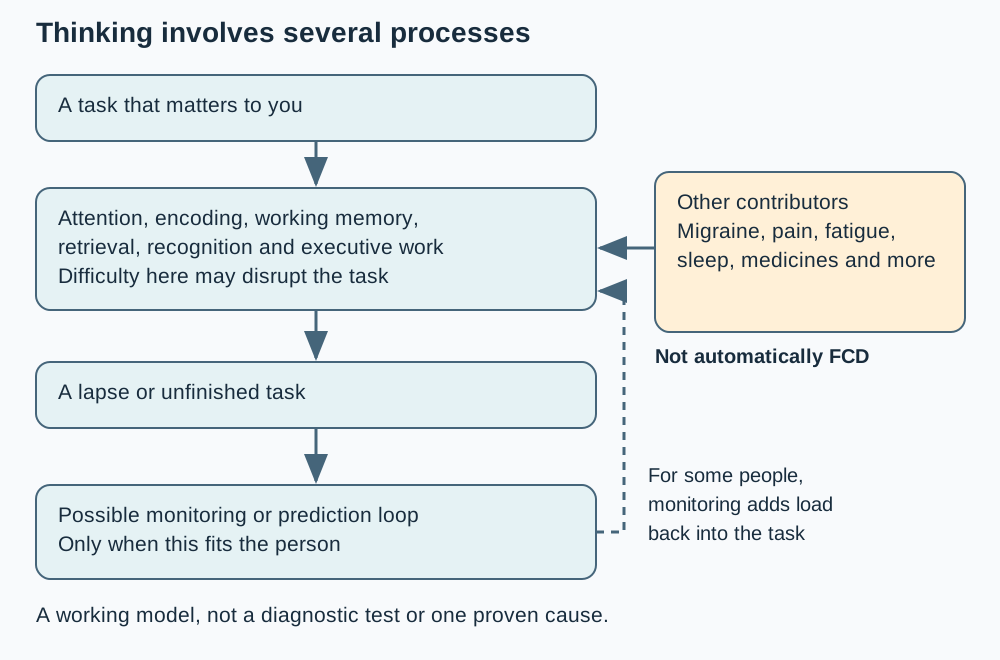
Conceptual illustration: possible relationships, not a diagnostic pathway or proven causal model. The dotted return path applies only when that loop fits the person’s experience.
Cause, trigger, mechanism and maintaining factor
| Term | The question it asks |
|---|---|
| Cause or predisposition | Why might this person have become vulnerable? Often there is no single known answer. |
| Trigger | What was happening when symptoms began or worsened? Timing alone does not prove causation. |
| Mechanism | Which process might be producing this difficulty now? |
| Maintaining or amplifying factor | What might keep the difficulty going or make it harder to manage? |
A recovery strategy can address something that maintains difficulty without proving what originally caused the disorder. Improvement with therapy is not a diagnostic test or evidence of a psychological cause. [1][2][3]
What brain research can and cannot tell us
FND research includes studies of brain activity, connections and structure. “Structural” and “functional” are not simple opposites. Group findings do not supply a diagnostic scan for one person or locate an “FND centre.”
One motor-FND study illustrates the limits: the whole patient group had no whole-brain-corrected cortical-thickness difference from controls, while dissociation measures had associations with particular regions. It did not study FCD or establish why a person has cognitive symptoms. The Module 3 research explanation gives the sample, findings and limits. It cannot be used to explain face-recognition or imagery changes in FCD. [6]
What this means for recovery
Support can combine three approaches:
- Restoration: practising a meaningful task at a manageable level, aiming to improve ability.
- Compensation: using a note, prompt, description or another route to get the task done.
- Accommodation: changing the environment or demands, such as allowing more time or reducing interruptions.
Supported success counts. Remembering an appointment through a calendar, finishing a conversation with a written cue, or recognizing someone after contextual help is real participation. Useful aids do not have to be withdrawn to prove recovery. [2]
Start with the task that matters to you. Make information easier to take in, reduce avoidable competing load, and keep needed checks. Monitoring exercises only fit if an unhelpful loop is actually present. Treat contributors alongside rehabilitation. Adjust practice to its immediate and delayed cost; pushing through is not a universal prescription.
The thirteen recovery pages describe education, practical guidance and emerging treatment packages—not thirteen independently proven mechanisms or cures. Choose relevant help with your team.
During a familiar flare
Use the short summary or aid you already know. Reduce competing input, ask for one idea at a time, and accept help with tasks you cannot manage safely. You do not need to work out the mechanism during the episode. Return to the explanation later if that is useful.
When the explanation may be incomplete
Seek urgent medical assessment for sudden confusion, altered consciousness or a cognitive change with new weakness, speech difficulty, severe headache, seizure, fever or head injury. New inability to recognize highly familiar people, progressive loss of familiar knowledge, getting lost in familiar places, major visual-spatial change or unsafe medication or financial errors also need reassessment. Urgency depends on onset and associated symptoms; sudden changes should not wait for routine follow-up. Existing FCD does not account automatically for something new. Pause activities you cannot manage safely. [3]
For the Person With FND
For Family, Friends, and Other Supporters
For Clinicians and the Care Team
Research and Sources
—
For Family, Friends, and Other Supporters
Ask what is missing before offering help. “Would my name and where we met help?” is kinder than turning recognition into a quiz. The person might know you but be unable to find your name, or recognize you while being unable to picture you later. Let them describe the difference.
Repeat essential information when it was forgotten or not understood. An agreed plan for recurring worry must not become a reason to withhold information. Offer one idea at a time during a familiar flare, and help access medical review for a changed pattern.
Keep useful notes, pictures or spoken cues available with permission. A supported conversation still belongs to the person; an aid is not evidence that they failed. Agree how much help they want, and protect privacy when using photographs or shared records. [2]
For the Person With FND
For Family, Friends, and Other Supporters
For Clinicians and the Care Team
Research and Sources
—
For Clinicians and the Care Team
Separate complaint, process-level hypothesis, observed impairment and diagnosis. Assess relevant domains rather than assuming a verbal-memory complaint: encoding, working memory, retention/retrieval, language, person knowledge/name access, recognition/familiarity, visual or nonverbal memory, visuospatial function, imagery, executive demands and cognitive communication as indicated. An imagery report is not interchangeable with visuospatial task performance. New face-recognition or imagery symptoms require a differential formulation, not inclusion as additional positive FCD signs. [1][3][7]
Demonstrate internal inconsistency within the relevant domain, accounting for cueing, load, fatigue and task demands. Explain uncertainty without equating variability with voluntary control. Review coexisting neurological, sensory, developmental, psychiatric, sleep, medication and systemic factors proportionately.
Document the target of each intervention: a cognitive process, an optional maintaining loop, a contributor or an access need. A response does not retrospectively prove the diagnosis or mechanism. Use participation, error burden, support needs, effort and delayed cost alongside symptoms. Provide continuing practical assistance when restoration is limited. [2][3]
For the Person With FND
For Family, Friends, and Other Supporters
For Clinicians and the Care Team
Research and Sources
—
Research and Sources
This is an additional background document, not a fourteenth recovery intervention. The memory tables and everyday examples are educational descriptions, not prevalence estimates. No community quotations have been added. Face/imagery adaptations apply general rehabilitation principles; direct FCD-specific efficacy has not been established by these sources.
| Citation | Source | What it supports and its limits | Figure |
|---|---|---|---|
| 1 | FND-CIT-0026 — McWhirter L, Ritchie C, Stone J, Carson A. Identifying functional cognitive disorder: a proposed diagnostic risk model. CNS Spectrums. 2022;27(6):754–763. DOI. | Diagnostic/formulation evidence; does not test the effectiveness of this practice. | — |
| 2 | FND-CIT-0011 — Nicholson C, Edwards MJ, Carson AJ, et al. Occupational therapy consensus recommendations for functional neurological disorder. JNNP. 2020;91(10):1037–1045. DOI. | Professional consensus for individualized rehabilitation, activity and support; not an FCD component efficacy trial. | — |
| 3 | FND-CIT-0071 — Ball HA, McWhirter L, Ballard C, et al. Functional cognitive disorder: dementia’s blind spot. Brain. 2020;143(10):2895–2903. DOI. | Clinical framework, cognitive heterogeneity and differential diagnosis; not a memory-subtype prevalence survey or treatment trial. | — |
| 4 | FND-CIT-0141 — Ball HA, Swirski M, Newson M, Coulthard EJ, Pennington CM. Differentiating Functional Cognitive Disorder from Early Neurodegeneration: A Clinic-Based Study. Brain Sciences. 2021;11(6):800. DOI. | Small clinic comparison: 21 FCD participants, 17 with neurodegenerative MCI and 25 controls. Illustrates uneven memory-test performance; cannot rank memory complaints or define every patient’s profile. | — |
| 5 | FND-CIT-0188 — Neurosymptoms.org. Functional Cognitive Symptoms. Specialist educational page. Accessed September 21, 2026. | Patient-facing explanation of attention, memory and the role of understanding symptoms; not evidence of standalone educational efficacy. | — |
| 6 | FND-CIT-0190 — Perez DL, Matin N, Williams B, et al. Cortical thickness alterations linked to somatoform and psychological dissociation in functional neurological disorders. Human Brain Mapping. 2018;39(1):428–439. DOI. | Motor-FND/dissociation structural MRI; not an FCD study, causal test or individual biomarker. | — |
| 7 | FND-CIT-0191 — Zeman AZJ, Della Sala S, Torrens LA, et al. Loss of imagery phenomenology with intact visuo-spatial task performance: a case of “blind imagination”. Neuropsychologia. 2010;48(1):145–155. DOI. | Single acquired-imagery case; supports separating imagery experience from task performance, not FCD prevalence or treatment. | — |
The conceptual diagram is an original educational synthesis of sources 1, 2, 3 and 5. Its arrows illustrate possible relationships; they are not measurements or proof that a loop occurs in everyone.
Source review: September 21, 2026 · Clinical, lived-experience and accessibility review pending
For the Person With FND
For Family, Friends, and Other Supporters
For Clinicians and the Care Team
Research and Sources
—