COURSE · PART 1 · MODULE 3 · PAGE 2
Brain Networks, Prediction, Attention, and Agency
Researchers have several ideas about how FND symptoms may be produced. These ideas involve brain networks, attention, predictions, past learning, automatic control and the sense that an action belongs to us. They are useful areas of study, but they do not yet provide one settled explanation or an individual diagnostic test. (*citations* [1](#citation-1), [2](#citation-2), [3](#citation-3))
For the Person With FND
For Family, Friends, and Other Supporters
For Clinicians and the Care Team
Research and Sources
—
For the Person With FND
The short version
The nervous system does not wait passively for information and then react. It constantly chooses what to pay attention to, uses earlier experience to anticipate what may happen, interprets signals from the body and surroundings, and organizes movement and awareness. Much of this happens automatically. [3]
Some FND theories propose that these ordinary processes are working together differently. That could help explain why a genuine symptom can occur without damage that appears on a standard scan and without the person deliberately causing it. The theories are not proof of what caused one person’s FND. [1][2][3]
What is a brain network?
A brain network is a group of brain areas that work together. Movement, sensation, attention, emotion, memory and awareness are not each controlled by one isolated spot. Networks share information, and the same area may contribute to several functions. [3]
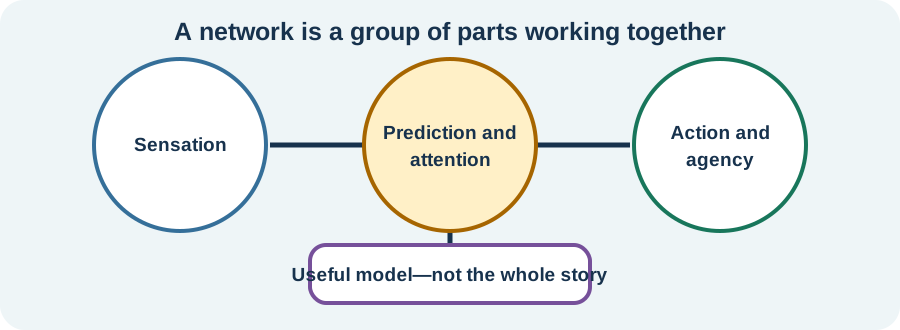
Illustration: networks help researchers organize possible relationships. They are not a complete personal explanation or diagnostic scan.
FND research has examined or discussed networks involved in:
- movement and motor control;
- attention and salience, meaning what the nervous system treats as important;
- interoception, meaning awareness and interpretation of signals from inside the body;
- emotion processing; and
- agency, meaning the sense that an action or experience belongs to you and is under your control.
Studies have reported group differences in several of these areas, but not every proposed process has been tested directly and the findings are not uniform. A difference on a research brain scan may help scientists form and test ideas, but it is not automatically a cause, a diagnostic biomarker or an explanation that applies to every participant. [1][2][3]
What a structural imaging study can show
Perez and colleagues compared 26 motor-FND patients with 27 controls. There was no whole-brain-corrected cortical-thickness difference for the complete FND group. Higher somatoform dissociation—a questionnaire measure concerning disrupted bodily experiences—was linked to thinner left caudal anterior cingulate cortex (ACC), in a high-score subgroup comparison and within-group analysis. Greater depersonalization/derealization was associated with thicker right lateral occipital cortex, not right ACC. [6]
The caudal ACC participates in integrating cognitive control, sensory/body information, affect and nociception (processing potentially harmful stimuli); it is not an FND centre. The paper discusses lateral occipital cortex in relation to higher-order visual processing, imagery and visual working memory. These are interpretations, not demonstrated explanations of FCD visual complaints.
This small cross-sectional motor-FND study was not an FCD study. Associations cannot determine cause, provide an individual diagnostic biomarker or identify a treatment target. Structural and functional research can coexist without making either a complete explanation. [6]
What do prediction and sensory evidence mean?
Predictive processing is a proposed way of describing how the nervous system combines expectations with incoming information. In simple terms, the brain anticipates what a signal probably means and checks that anticipation against sensory evidence from the body and surroundings. [1][3]
Researchers sometimes use the term precision weighting for how much confidence or importance the nervous system gives to a prediction or to new sensory information. Active inference is a related proposal in which perception and action work together to reduce the difference between what is expected and what is sensed. [1][3]
These processes are mostly automatic. Saying that expectations may influence a symptom does not mean that the person expected it on purpose, imagined it or can stop it by “thinking positively.” Past learning can shape automatic predictions without a person knowing that it is happening. [1][3]
How can attention affect a real symptom?
Attention helps the nervous system decide which information receives priority. It can be deliberately directed, but it can also be captured automatically by pain, danger, an unusual sensation or the effort required to complete a movement.
Some functional symptoms change when attention or the way a task is performed changes. For example, a movement may be easier when it happens automatically as part of another task than when the person concentrates directly on it. This kind of difference may provide positive diagnostic evidence and may suggest a rehabilitation approach. It does not mean that every symptom improves with distraction or that attention alone caused the disorder. [1][3][4][5]
What is a changed sense of agency?
A movement can occur while the person does not experience it as chosen or controlled. Researchers describe this as an altered sense of agency. This may help explain why tremor, jerks, fixed postures or other movements can feel as though the body is acting on its own. [1][3]
Agency is not the same as responsibility. A theory about how the nervous system marks an action as voluntary does not make an involuntary FND symptom voluntary.
What is measured, and what is still a model?
Researchers can measure behaviour during tasks and group patterns in brain activity or connections. From those results they propose explanations involving attention, salience, emotion, interoception, prediction, sensory evidence and agency. [1][2][3]
The measurement and the explanation are not the same thing. Studies may be small, may include different symptom types and may not show which finding came first. Researchers do not yet have one network pattern or prediction measure that can diagnose FND in an individual. A model may still be useful for treatment even when it is incomplete or later changes. [1][2][3]
Community experiences for review
These are two candidate lived-experience quotations from the project’s community collection. They illustrate different ways that attention and surroundings were associated with symptom change for two individuals; they do not show conscious control or a method that everyone should try.
Option 1 — attention directed elsewhere
“If I meditate or focus on something else I can stop it.”
— The writer described head jerking that changed when their attention was directed elsewhere. Read the public source.
Option 2 — mirror attention and background distraction
“I never do any of this in a mirror … with some sort of background distraction.”
— The writer reported that looking in a mirror worsened their facial symptoms and described using background distraction instead. This does not show that mirrors are harmful for everyone. Read the public source.
Questions
Have you noticed that a familiar symptom or ability changes with the task, your surroundings or where your attention is drawn, without you choosing the change?
Which parts of these brain-network explanations help you make sense of your experience, and which parts still feel like unanswered theory?
What can you safely try at home?
Choose one explanation you have been given about your symptoms and divide it into three short parts:
- What was observed: for example, a movement changed during an examination.
- What was proposed: for example, attention or automatic control may be involved.
- What it means for me: what the observation may help with, and what it does not prove.
A lower-demand version is to write only: “The observation was __; the explanation offered was __.”
Do not provoke symptoms, repeatedly test yourself, or ask someone to distract or surprise you to see what happens. Stop if the exercise increases symptoms, distress or constant self-monitoring. A clinician or therapist can help when an observation needs medical interpretation or when you want to use it in a treatment plan.
For the Person With FND
For Family, Friends, and Other Supporters
For Clinicians and the Care Team
Research and Sources
—
For Family, Friends, and Other Supporters
A change in a symptom during distraction, automatic movement or a different setting does not show that the person was pretending before the change. It may show that the nervous system can access a function under some conditions even though the person cannot reliably control when that happens.
Do not secretly test the person, draw attention to every movement, or insist that they should be able to repeat a better moment. That turns support into surveillance and can damage trust.
If the person finds one of these models useful, ask what it helps them understand or practise. If the model does not fit their experience, do not force it. Practical help can still focus on safety, reduced demands, treatment access, communication and meaningful activity without agreeing on one mechanism.
New or substantially changed symptoms still deserve appropriate assessment. A brain-network theory should never be used to explain away a medical change.
For the Person With FND
For Family, Friends, and Other Supporters
For Clinicians and the Care Team
Research and Sources
—
For Clinicians and the Care Team
Research quotations for review
These quotations are offered as two possible evidence anchors for this section. Both papers describe developing research frameworks; neither establishes an individual diagnostic biomarker.
Option 1 — Drane et al., 2021
“In this perspective article, we briefly review five constructs that are affected in FND: emotion processing (including salience), agency, attention, interoception, and predictive processing/inference.”
Option 2 — Bègue et al., 2019
“it remains unclear whether structural alterations relate to predisposing vulnerabilities or consequences of the disorder.”
Figure 1 — Research quotations offered for editorial selection. [2][3]
Explain the level of evidence
Separate the patient’s demonstrated clinical findings from research results and mechanism models. Task-based behavioural differences or positive signs may support diagnosis. Group differences in functional imaging or connectivity do not currently provide an individual diagnostic biomarker. [1][2][3]
When using predictive-processing or active-inference language, explain prediction, sensory evidence and precision without implying conscious expectation. When discussing attention, distinguish an automatically captured process from deliberate focus. When discussing agency, state directly that an altered feeling of control does not make the symptom voluntary. [1][3]
Connect assessment to the patient’s presentation
Begin with history, symptom form and time course, positive signs, and relevant neurological examination. Use targeted tests and specialist assessment for defined differential or comorbidity questions. Research measures of salience, interoception, emotion processing, connectivity or agency should not be presented as clinical proof unless they have been validated for that purpose. [1][2][3][4]
Interpret studies with attention to sample size, symptom mix, medication, psychiatric and neurological comorbidity, task design, replication and direction of effect. A difference associated with FND may be a contributor, consequence, compensation or unrelated group finding. [2][3]
Use models to support care, not restrict it
A model may help a patient understand an examination finding or engage with motor retraining, attention strategies or another individualized intervention. Choose language with the patient and keep the treatment goal meaningful even if the proposed mechanism remains uncertain. [4][5]
Treatment response does not confirm the model or reveal the original cause. Do not make acceptance of one theory a condition of care. When symptoms persist, continue validation, symptom management, safety planning, accessibility, participation and agreed reassessment. [1][4][5]
New, severe, injured or substantially changed symptoms require proportionate medical review rather than automatic attribution to the existing formulation.
For the Person With FND
For Family, Friends, and Other Supporters
For Clinicians and the Care Team
Research and Sources
—
Research and Sources
What this evidence can and cannot establish
The broad Hallett review and Drane perspective describe developing network and predictive-processing models. The Bègue systematic review reports structural findings in some study groups but states that their meaning and direction remain uncertain. Bennett’s clinical review and the physiotherapy consensus connect attention and automatic movement to clinical explanation and rehabilitation; the consensus is professional guidance, not proof that one mechanism or technique applies to every FND presentation. None of these sources supplies an individual brain-scan or network biomarker for FND. [1][2][3][4][5]
Citation table
| Citation | Figure | Full citation |
|---|---|---|
| [1] | — | Hallett M, Aybek S, Dworetzky BA, McWhirter L, Staab JP, Stone J. Functional neurological disorder: new subtypes and shared mechanisms. The Lancet Neurology. 2022;21(6):537–550. FND-CIT-0003. https://doi.org/10.1016/S1474-4422(21)00422-1 |
| [2] | Figure 1 | Bègue I, Adams C, Stone J, Perez DL. Structural alterations in functional neurological disorder and related conditions: a software and hardware problem? NeuroImage: Clinical. 2019;22:101798. FND-CIT-0004. https://doi.org/10.1016/j.nicl.2019.101798 |
| [3] | Figure 1 | Drane DL, Fani N, Hallett M, Khalsa SS, Perez DL, Roberts NA. A framework for understanding the pathophysiology of functional neurological disorder. CNS Spectrums. 2021;26(6):555–561. FND-CIT-0006. https://doi.org/10.1017/S1092852920001789 |
| [4] | — | Bennett K, Diamond C, Hoeritzauer I, Gardiner P, McWhirter L, Carson A, Stone J. A practical review of functional neurological disorder (FND) for the general physician. Clinical Medicine. 2021;21(1):28–36. FND-CIT-0001. https://doi.org/10.7861/clinmed.2020-0987 |
| [5] | — | Nielsen G, Stone J, Matthews A, et al. Physiotherapy for functional motor disorders: a consensus recommendation. Journal of Neurology, Neurosurgery & Psychiatry. 2015;86(10):1113–1119. FND-CIT-0028. https://doi.org/10.1136/jnnp-2014-309255 |
| [6] | — | Perez DL, Matin N, Williams B, et al. Cortical thickness alterations linked to somatoform and psychological dissociation in functional neurological disorders. Human Brain Mapping. 2018;39(1):428–439. DOI. FND-CIT-0190. Motor-FND/dissociation associations; not causal evidence or an FCD biomarker. |
This page still needs review by people with FND, supporters, clinicians and researchers, especially to ensure that proposed models remain clearly separate from diagnostic evidence.
Plain-language draft prepared: September 4, 2026 · Research package added September 4, 2026 · Clinical review pending