
COURSE · PART 1 · MODULE 4 · PAGE 2
Building and Using Your Personal Symptom Map
In Lesson 10, we began sorting our health story into known diagnoses and open questions. Now let's make a short map that also shows what helps and what remains possible.
For the Person With FND
For Family, Friends, and Other Supporters
For Clinicians and the Care Team
Research and Sources
—
For the Person With FND
Remember what remains possible
A symptom map can show more than the difficulties you’re dealing with. It can also make room for the things that help you participate in daily life.
Some activities feel different depending on the surroundings, the support available or how your symptoms are behaving that day.
Those differences can give you useful information.
Perhaps speaking is easier in a quiet room.
Maybe walking is more manageable with a particular aid or support.
Someone with functional cognitive difficulties might find that written instructions help them follow a conversation or complete a task.
Another person may have good periods between episodes, even though the episodes themselves are very disabling.
These details can help show where useful adjustments or treatment might begin.
And an ability that comes and goes is still a real ability, just as the difficulty is real when it happens. Changes in what you can do are a recognized part of how some FND symptoms appear. [1][5]
Someone in the FND community put the value of an aid this way:
“My mobility aids have been incredibly helpful and enable me to live life more fully.”
Figure 1. Mobility aids and participation; individual lived experience. [7]
For this person, the aid helped make more of life possible. Your helpful adjustments may look entirely different.
What can a map do for you?
Think about all the details you might want to remember when talking about your health.
There’s what has already been diagnosed. There are questions you’re still trying to understand. And there are the little discoveries that make a difficult day easier.
A personal symptom map gives these pieces a place to live.
It might help you explain a change to a clinician, remember an adjustment that worked, or tell someone what support would make an activity more manageable.
The map can be a short, one-page reminder. It holds the important points so you don’t have to remember everything at once.
For some people, that’s a big deal.
One community member described how much memory difficulties affected everyday care:
“Currently I can barely take care of myself because of them. My partner has to remind me to take my pills, which ones to take when, and instructions for taking them.”
Figure 2. Memory and everyday reminders; individual lived experience. [8]
That’s one person’s experience. It shows why an outside reminder—or help from someone you trust, if you have and want that support—can be valuable. You can also make and use a map on your own.
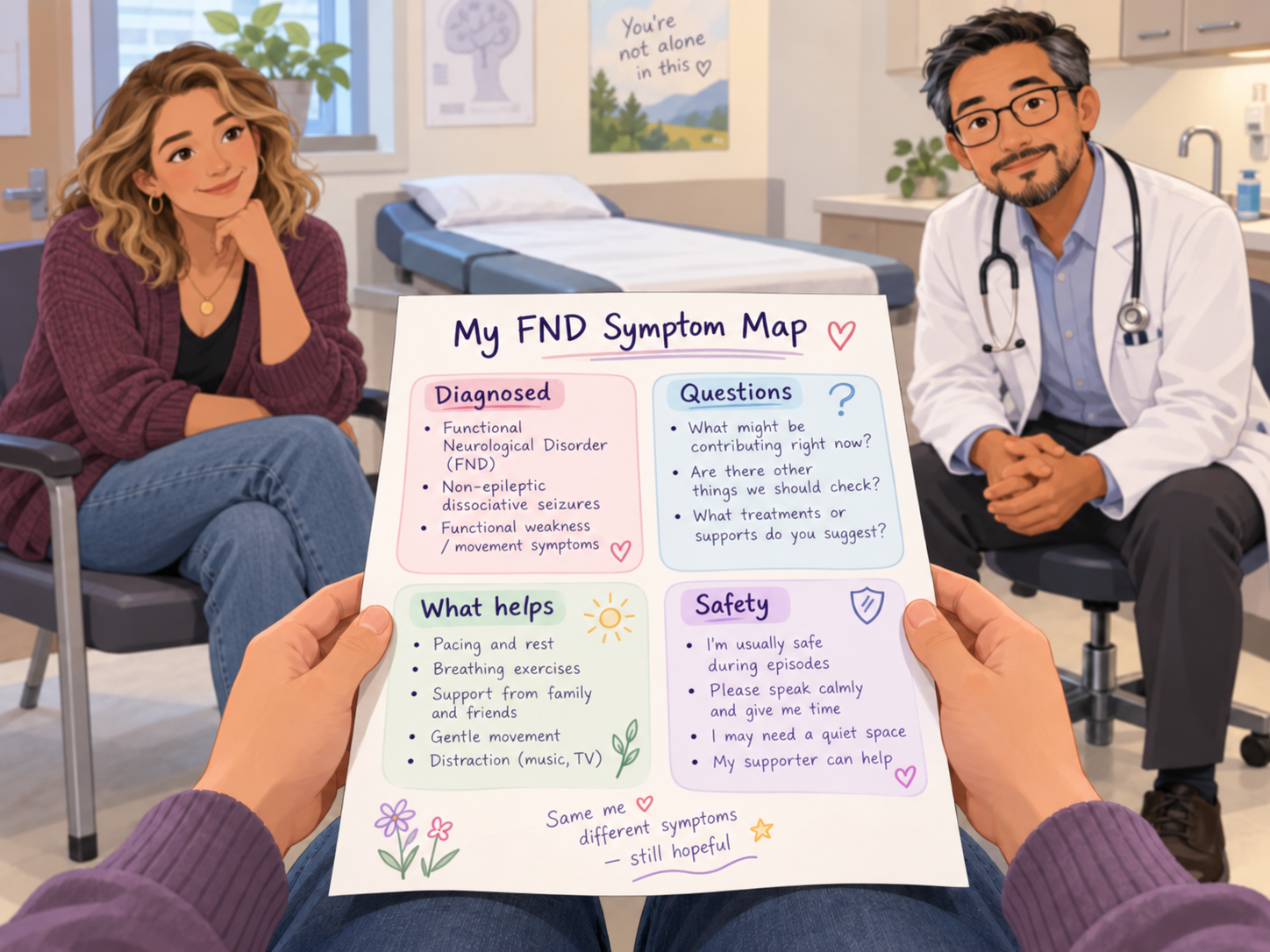
What belongs on the page?
Your map could have a place for a condition that’s been diagnosed, along with a separate space for a symptom that still needs assessment.
It could also describe a safety need, something that makes daily life easier, or a change you’d like your care team to know about.
You might be mapping functional seizures, movement, speech, sensation, thinking or a mixture of symptoms. Your headings can fit your experiences.
Imagine that quieter surroundings make conversations easier. That belongs on the map.
Perhaps a medication change seems connected with a new symptom. You could write down the change and bring that question to your clinician.
And maybe a walking aid helps you enjoy an outing. That’s worth remembering, too.
The map is a quick guide to what matters to you. Detailed medical records can stay somewhere else, while medical assessment helps establish what caused a symptom.
Building your own map
Ready to give it a try?
You can begin with just four short lines. Here’s what one person’s page might say:
- My diagnosed conditions: Functional leg weakness and migraine.
- My unanswered question: New dizziness — ask a clinician when and how it should be assessed.
- My safety needs: A walking aid and a plan for getting help when needed.
- What helps: Quieter surroundings, written reminders and rest between demanding activities.
There you go. That’s a symptom map.
It’s hardly a bestselling novel, but it could make a doctor’s appointment a lot easier!
You can build on it when something important changes. A page with only a few useful details is a good beginning.
Printable worksheet: Download your Symptom Map (PDF). Page 1 has soft grey italic prompts to help you begin. Page 2 uses the same layout with open space for writing, doodling or colouring. Print whichever page suits you.
When is tracking useful?
A map is your short reference. A diary is different: it can help you explore a specific question for a little while.
For example, suppose appointments leave you exhausted. You’re wondering whether a quieter waiting area or a break beforehand might help.
For a short time, you could make a note of what the appointment involved, how you managed and what recovery was like afterwards.
That gives you something practical to discuss with your care team.
Sometimes a small observation suggests an adjustment worth exploring. One community member wrote:
“I was able to figure out that my post-eating issues were actually auditory sensory overload … and really cut those specific symptoms down by using ear plugs.”
Figure 3. One person’s sensory experience; individual lived experience. [9]
That’s how this person understood their experience. It’s a reminder that surroundings can matter, while symptoms after eating—especially choking or swallowing difficulties—still deserve appropriate medical assessment to check safety and other possible causes.
A pattern is a clue to explore. Understanding its cause takes more evidence. Symptoms can vary naturally, and a few observations may tell only part of the story. [3][6]
Here’s a useful question whenever you consider tracking something:
“What would I use this information for?”
You can decide with your care team what is worth noting and when to review it. Once the question has been answered as well as possible, you can set the diary aside.
After all, there’s more to life than keeping records!
A map that grows with you
Your health may change over time. So can your map.
A newly diagnosed condition can move from the questions section to the diagnoses section.
A helpful strategy can be added when you discover it. Your safety plan can change when your needs do.
A sudden, severe or substantially different symptom may call for timely medical advice, and urgent warning signs need emergency assessment. A map can help you describe a change, alongside the care you receive.
Perhaps you prefer typing a few words on your phone. Or someone you trust could write while you explain what you want included.
If concentrating on symptoms becomes overwhelming, a shorter map or a break from tracking may work better.
The map belongs to you. You decide what to include, whom to share it with and when it’s useful.
Something to think about
Imagine showing your map to someone who knows very little about your health.
What is the first thing you’d want them to understand?
And what one unanswered question would you most like help with?
Those two thoughts could be a good place to start.
What can you try at home?
Find a piece of paper or open a note on your phone.
Write down one diagnosed condition, one question you’d like to ask and one thing that helps you manage daily life.
That’s enough for a first version. Add to it whenever it helps you.
Your health story is much bigger than a page of notes. The map simply helps you carry the important pieces when you need them.
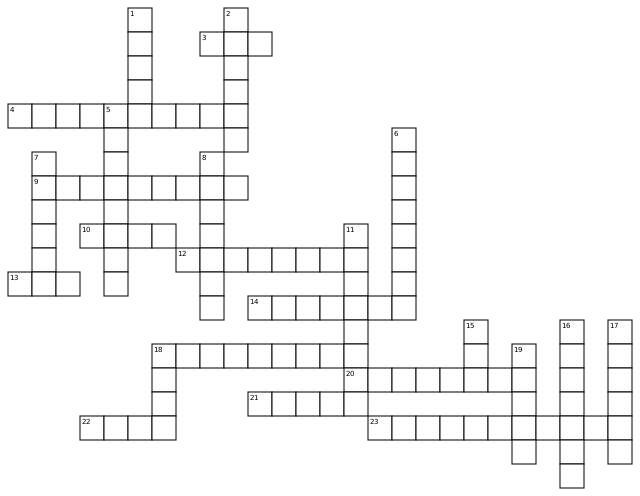
Optional crossword
Revisit the lesson with a crossword. The easy edition includes a word bank.
Optional colouring activity
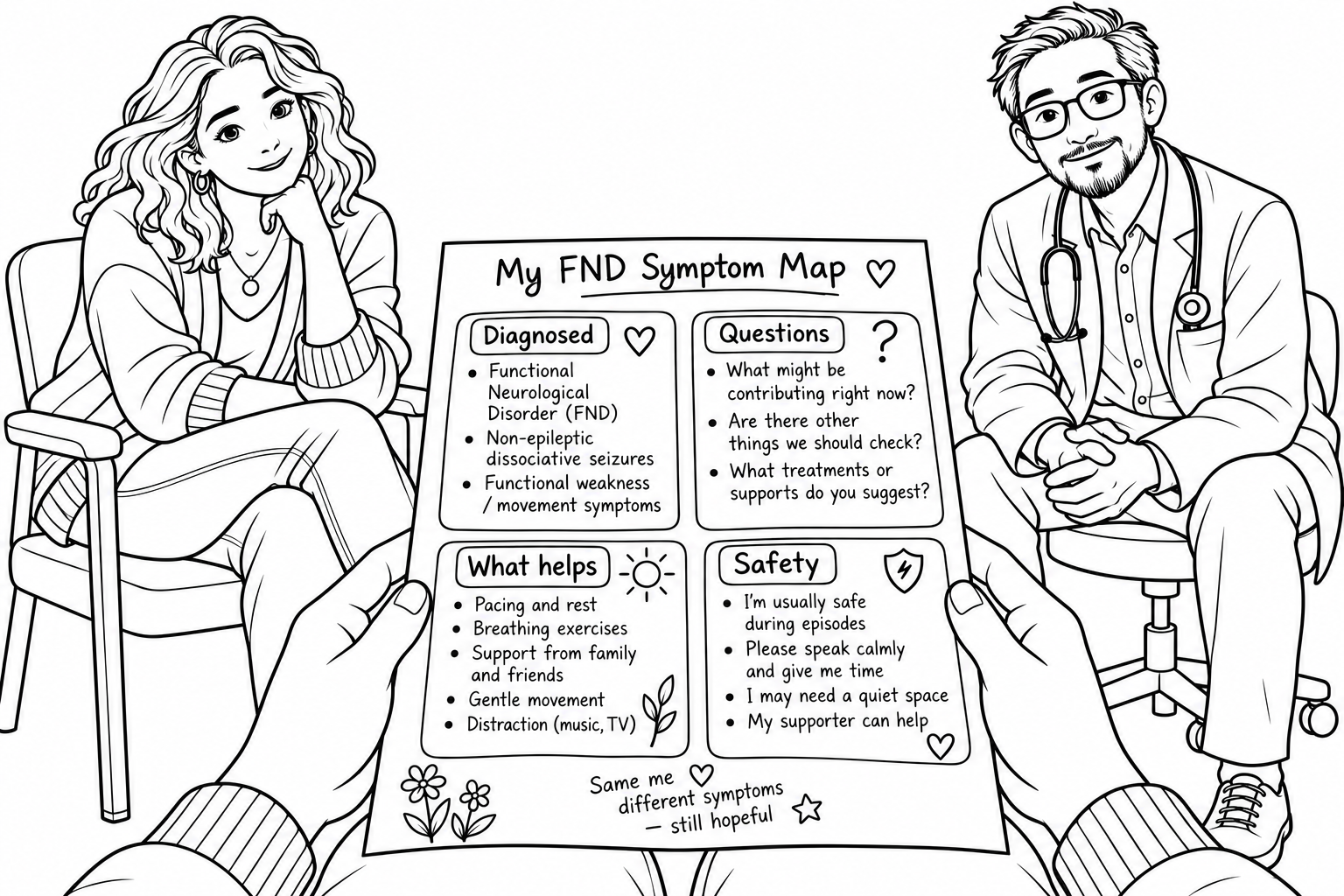
Open the Lesson 11 colouring PDF (new tab), or browse the colouring collection.
For the Person With FND
For Family, Friends, and Other Supporters
For Clinicians and the Care Team
Research and Sources
—
For Family, Friends, and Other Supporters
A useful map should lighten the load
Remembering dates, diagnoses and changes can make a short appointment surprisingly demanding. For someone who experiences fatigue, speech or cognitive difficulties, reconstructing the whole story may use energy they need for the conversation itself.
A supporter might be thinking, “But I remember all of that already!”
And they may be right. After years together, they might know the person’s symptoms, appointment history and familiar routines better than anyone.
The person with FND may still find it difficult to call up those details when they need them. Imagine being asked a question at an appointment and knowing that the answer exists somewhere in your life, but finding your thoughts suddenly out of reach.
A few agreed notes can help both people. The person has information they can use without relying on someone else being present. The supporter can share what they know without carrying the whole history in their head at every appointment.
The person with FND decides what belongs on their map and who gets to see it. Some people welcome a supporter who helps write things down; others prefer to manage their information independently.
A friendly question might be: “Which part would you like help with, if any?”
Include more than symptoms
Imagine someone who sometimes finds speaking difficult.
During a medical appointment, they struggle to get their words out. Later, in a quieter room, conversation feels easier.
Their supporter remembers the busy waiting area. The person remembers how much effort it took to answer a simple question.
Together, they have something useful to say about what helps. The person might choose to put this on their map:
“I sometimes need extra time to speak. A quieter space helps me take part in conversations.”
That little note gives someone reading the map more than a symptom description. It offers an idea for making the next appointment easier.
Now imagine they’ve already spent years making daily life more manageable. Perhaps they’ve found quieter places to talk, ways to rest after outings and a signal to use when speech becomes difficult.
Those adaptations are knowledge they’ve built together. The map can hold a few of the most useful discoveries. It can begin with what already works, rather than asking the family to catalogue every symptom or reinvent years of experience.
What another person can add
Someone may have familiar episodes during which they find it hard to respond.
They remember feeling confused before an episode. Their supporter remembers seeing them become quiet and noticing that they needed time afterwards to recover.
Those are two views of the same experience.
The supporter might offer to describe what they saw. The person can decide whether that observation belongs on the map, perhaps beside their existing episode safety plan.
It’s a bit like two people describing the same journey: one remembers the bumpy road; the other remembers where they had to stop. Together, their accounts may give a fuller picture.
As we learned in Lesson 10, describing what happened is different from deciding why. That medical interpretation belongs with the clinician.
Someone without a supporter can still describe what they experienced and what they need. A map can also hold the person’s own account.
Sharing the work, keeping room for life
Even helpful tasks add up. Remembering medications, arranging transport, answering questions, watching for changes and managing appointments can gradually fill a supporter’s day.
Imagine a couple deciding to spend ten minutes before an appointment choosing the most important notes. One person explains what they want included; the other helps put it into words.
Then the notes are ready, and they can spend the rest of their evening being a couple rather than an administrative department.
That’s a boundary: an agreement about what help is useful, who can offer it and when to ask for another kind of support. A family member can care deeply and still need time for their own rest, health and interests. When care demands more than one person can comfortably provide, professionals, community services or additional trusted people may be part of a sustainable plan.
The best arrangement is one both people can live with. And a person who manages FND on their own can choose similarly simple systems that leave space for the rest of life.
Give tracking a purpose
Suppose long appointments leave someone exhausted. They wonder whether a shorter visit or a quiet place to rest might make things easier.
Rather than recording every symptom, they try a few brief notes after appointments: what was different, what helped and how recovery went.
At the next visit, they might say:
“The appointment with a break felt more manageable. Could we plan something similar next time?”
They’ve used their notes to start a useful conversation. A few experiences can suggest an adjustment worth exploring. Understanding what caused the difference takes further assessment.
Once those notes have answered the question as well as possible, they can be set aside. A supporter may help if invited, or the person may prefer to keep a couple of words on their phone.
The map can change as life changes. It helps carry familiar information between conversations, while new, severe or substantially different health concerns still deserve medical attention based on their urgency.
The useful map is the one that helps the person be understood while leaving both people more energy for living.
For the Person With FND
For Family, Friends, and Other Supporters
For Clinicians and the Care Team
Research and Sources
—
For Clinicians and the Care Team
A patient-owned map, built with clinical support
The personal symptom map introduced in this course is a short, patient-owned guide to the information someone wants available when discussing their health.
The person with FND chooses whether to make one, what belongs on it and whom to share it with. They might put it together independently, ask a supporter for help or work on it with a clinician.
The clinician’s contribution is particularly valuable where medical details need precision. A brief written explanation can identify the positively diagnosed functional presentation, its supporting findings and any questions that still need clinical assessment. The person can then decide how much of that explanation belongs in their map.
In practice, a map might hold:
- Diagnosed FND symptoms: the specific presentation, with a reference to the supporting clinical findings.
- Other health conditions: established diagnoses recorded separately.
- Questions still open: new or uncertain symptoms and the agreed next step.
- Abilities and helpful adjustments: what the person can do, what makes participation easier and what matters to them.
- Safety and follow-up: agreed warning signs, practical arrangements and routes to care.
These are starting points rather than required fields. A few useful lines may be enough, especially when writing or remembering is demanding.
Make the clinical reasoning available
Lesson 10 distinguished a positively diagnosed functional presentation from coexisting conditions and questions that still need assessment. Here, the aim is to preserve that reasoning in a form the person can carry into the next appointment.
Consider someone with functional leg weakness, diagnosed migraine and new dizziness.
Their clinical record contains the positive findings supporting the functional weakness diagnosis. Their migraine is an established, separate condition. Coexisting conditions are part of the wider health picture reported in FND research. [4] The dizziness remains a question for assessment.
A short personal map can preserve those distinctions and point to the relevant clinical record. It can also identify the agreed next step for the dizziness, according to the history and examination.
The aim is continuity: a future clinician can see which conclusion is supported, what supports it and which question remains open. That allows new or changing symptoms to receive an assessment proportionate to their presentation, while established findings remain available for care planning. [1]
This course proposes a communication format. Clinical examination, diagnostic reasoning and appropriate investigation continue to provide the basis for medical conclusions.
Connect the formulation to daily life
A diagnostic summary describes the condition. The next useful question is often how the person manages the activities that matter to them.
Imagine that conversation is difficult in a busy waiting room but becomes easier in a quiet consultation space.
Recording this difference offers a practical possibility: the care team might arrange a quieter setting or allow more time for responses.
It also preserves the full clinical picture. Easier speech in one environment and disabling speech difficulty in another are both meaningful observations.
The same reasoning may apply when movement becomes more manageable with an aid or a particular strategy. Occupational therapy and physiotherapy consensus recommendations support attention to functional performance, meaningful activities and individually tailored rehabilitation. An individualized equipment review can bring together safety, fit, participation goals and rehabilitation needs. These recommendations provide a clinical framework; the value of an adjustment is assessed with the individual. [2][5]
Progress can therefore be described in terms of participation, safety, access or quality of life, alongside symptom change.
Choose a question before choosing a measure
A symptom diary becomes clinically useful when it is linked to a decision.
Suppose a person leaves appointments exhausted. They and their clinician wonder whether a rest break or a different appointment format might help.
A brief account of what was tried, how manageable the visit felt and what recovery was like afterwards may inform that discussion.
The patient’s report is central. Examination findings and observations from a supporter chosen by the patient can add different kinds of information when relevant.
(In a 2025 qualitative study of FND outcome measurement, Rutten and colleagues explored the views of patients, caregivers and healthcare professionals. The researchers reported:)
“all believed that the patient’s subjective experience should be central.”
Figure 4. Rutten et al. (2025), Abstract—Results. [3]
This places the person’s account of meaningful change alongside clinical observations when planning or evaluating care.
There is also a limit to what a short record can establish. Symptoms may vary between days, recall can be difficult, and understanding why an adjustment was followed by improvement still takes clinical judgment.
Qualitative and systematic work on FND outcome measurement supports listening to the patient’s priorities and interpreting measures in context. Validation of this course’s one-page map, or evidence that intensive daily tracking improves care, would require separate studies. [3][6]
A proportionate plan can identify one question, a manageable amount of information and a time to review it. The person can then keep what helps and set aside record-keeping that has served its purpose.
Make the plan accessible and sustainable
The next appointment is more useful when the person can reach it and participate in it.
For someone whose symptoms are aggravated by travel, waiting, noise or prolonged communication, a written summary, quieter setting or remote discussion may reduce the burden where the clinical question allows it.
Some concerns call for an in-person assessment. Others need urgent or emergency care. The care plan can explain how the person should seek help for meaningful changes and how urgency will be judged clinically. [1][2]
Support may come from a family member, friend or care professional. Some people attend alone. Either way, the person’s consent and preferred way of communicating guide what information is shared.
After years of illness, a family may already have developed useful routines and adaptations. Inviting those discoveries into the map respects experience already gained.
At the same time, a sustainable plan considers the supporter’s capacity. The clinical team can provide an accessible written summary and agreed follow-up steps, keeping the record-keeping workload realistic for the person and any supporter.
A useful map carries forward the reasoning, practical adjustments and next decisions. It becomes easier to update as diagnoses, abilities or circumstances change.
For the Person With FND
For Family, Friends, and Other Supporters
For Clinicians and the Care Team
Research and Sources
—
Further reading in the Reference Library: Thinking and memory supports · Communication access
Research and Sources
What this evidence can and cannot establish
Occupational-therapy and physiotherapy consensus guidance discusses variable function, meaningful activity and individualized care. Qualitative and systematic outcome studies highlight patients’ experiences and the limitations of individual measures. These sources support thoughtful communication and care planning; they do not validate this course’s one-page map as a diagnostic or treatment tool. Community quotations represent individual experiences, not evidence that an aid, reminder or other strategy will work for everyone. The community excerpts and selected Rutten quotation were checked against their original sources on October 23, 2026. [1][2][3][5][6]
Citation table
| Citation | Figure | Full citation |
|---|---|---|
| [1] | — | Bennett K, Diamond C, Hoeritzauer I, Gardiner P, McWhirter L, Carson A, Stone J. A practical review of functional neurological disorder (FND) for the general physician. Clinical Medicine. 2021;21(1):28–36. FND-CIT-0001. https://doi.org/10.7861/clinmed.2020-0987 |
| [2] | — | Nicholson C, Edwards MJ, Carson AJ, et al. Occupational therapy consensus recommendations for functional neurological disorder. Journal of Neurology, Neurosurgery & Psychiatry. 2020;91(10):1037–1045. FND-CIT-0011. https://doi.org/10.1136/jnnp-2019-322281 |
| [3] | Figure 4 | Rutten S, Bradley-Westguard A, Nicholson TR, et al. Outcome measurement in functional neurological disorder: a qualitative study on the views of patients, caregivers and healthcare professionals. Journal of Neurology. 2025;272:189. FND-CIT-0012. https://doi.org/10.1007/s00415-025-12912-9 |
| [4] | — | Butler M, Shipston-Sharman O, Seynaeve M, et al. International online survey of 1048 individuals with functional neurological disorder. European Journal of Neurology. 2021;28(11):3591–3602. FND-CIT-0014. https://doi.org/10.1111/ene.15018 |
| [5] | — | Nielsen G, Stone J, Matthews A, et al. Physiotherapy for functional motor disorders: a consensus recommendation. Journal of Neurology, Neurosurgery & Psychiatry. 2015;86(10):1113–1119. FND-CIT-0028. https://doi.org/10.1136/jnnp-2014-309255 |
| [6] | — | Pick S, Anderson DG, Asadi-Pooya AA, et al. Outcome measurement in functional neurological disorder: a systematic review and recommendations. Journal of Neurology, Neurosurgery & Psychiatry. 2020;91(6):638–649. FND-CIT-0067. https://doi.org/10.1136/jnnp-2019-322180 |
| [7] | Figure 1 | Public Reddit comment by JelloAdventurous in “Advice needed: considering using mobility aid for leg weakness.” r/FND. Original source. Verified October 23, 2026. Individual lived experience. FND-CIT-0290. |
| [8] | Figure 2 | Public Reddit post by liamreee. “Memory issues?” r/FND. Original source. Verified October 23, 2026. Individual lived experience. FND-CIT-0291. |
| [9] | Figure 3 | Public Reddit comment by Vellaciraptor in “Choking.” r/FND. Original source. Verified October 23, 2026. Individual lived experience. FND-CIT-0292. |
All three audience sections are human-authored revisions with AI assistance and have been approved by the project lead. Community quotations remain individual experiences. Source verification and the project’s evidence and editorial audits are complete; independent clinical review remains pending.
Plain-language draft prepared: September 4, 2026 · Human-authored revision approved: October 23, 2026 · Audit 1 and Audit 2 completed: October 23, 2026 · Clinical review pending