COURSE · PART 1 · MODULE 4 · PAGE 1
Build and Use Your Personal Symptom Map
When symptoms, diagnoses, possible triggers, medications and unanswered questions are held in memory as one large list, it can be difficult to know what is established and what still needs attention. A personal symptom map separates these parts without asking you to diagnose them yourself. (*citations* [1](#citation-1), [3](#citation-3), [6](#citation-6))
For the Person With FND
For Family, Friends, and Other Supporters
For Clinicians and the Care Team
Research and Sources
—
For the Person With FND
What is a personal symptom map?
In this course, a personal symptom map means a short, updateable record of what is known about your FND and other health conditions. You may also see records described as an FND symptom map, comorbidity map or symptom diary. These are practical descriptions, not the name of a diagnostic test.
The map can help you prepare for an appointment, explain your condition to a new clinician or supporter, notice a meaningful change and remember what has helped. It should reduce memory work, not require you to watch every sensation throughout the day. This one-page map is a project framework, not a validated diagnostic or treatment tool. [2][3][6]
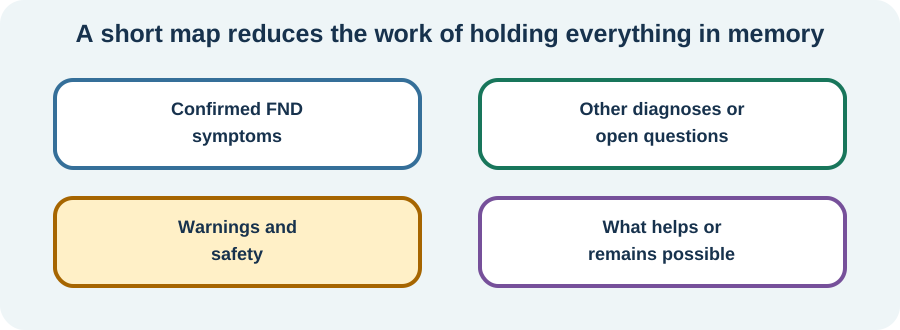
Illustration: keeping the categories separate reduces memory work and leaves uncertain symptoms open for assessment.
Keep different kinds of information separate
| Part of the map | What belongs there |
|---|---|
| Confirmed FND symptoms | Symptoms a clinician has identified as functional, along with the positive evidence when you know it. |
| Associated symptoms | Problems that may be common alongside FND but have not automatically been diagnosed as FND. |
| Separate diagnoses | Other diagnosed neurological, medical, sleep or psychiatric conditions. |
| Unresolved symptoms or questions | Symptoms still awaiting assessment and questions for which you have not received a clear answer. |
| Medication effects | Intended effects, side effects, withdrawal effects or changes that may need review. |
| Possible triggers and warning signs | Patterns that may increase the chance of symptoms, kept separate from signs that an episode or flare may already be beginning. |
| What helps or makes things harder | Strategies, surroundings, supports and demands that appear to change safety, function, comfort or recovery. |
| Preserved abilities | Things that remain possible, or become possible under some conditions, even when another version of the task is difficult. |
| Meaningful changes | New, substantially different or sustained changes that may affect safety, treatment or the need for reassessment. |
Do not move an uncertain symptom into the FND section simply because you already have an FND diagnosis. A symptom can remain under unresolved until it has been properly assessed. [1][4]
Trigger, warning sign or consequence?
These words describe different places in time:
- A vulnerability or risk factor may exist well before a symptom.
- A trigger may increase the chance of an episode or flare.
- A warning sign may show that the episode or flare has already begun.
- A maintaining factor may help a symptom continue or make it harder to change.
- A consequence happens because of the symptom, such as an injury, missed activity or need for recovery.
For example, poor sleep might be a possible trigger on some days. A familiar change in speech might be an early warning that a person’s episode is starting. Exhaustion afterwards would be a consequence. The timing may differ for another person, and seeing a pattern once does not establish it as a cause.
Record abilities as well as difficulties
FND symptoms can vary across a day, week, activity or situation. A movement may be difficult when attempted directly but easier within an automatic or familiar task. Speech may change in a busy setting but be clearer in a quieter one. An episodic symptom may be absent between events, while another symptom lasts much longer.
Recording these differences does not minimize the disabling periods. It may show what remains available, what surroundings or methods help, and where treatment or support could begin. A preserved ability is not proof that the difficult version is voluntary. [1][5]
Build a one-page map
Begin with only what could change a decision. You can use this order:
- My confirmed FND symptoms: list the symptoms that have actually been diagnosed as functional.
- My other diagnoses: keep each separate condition on its own line.
- Still unexplained or awaiting assessment: record the question without trying to solve it.
- My familiar warning signs and safety plan: include what happens next and when help is needed.
- Possible influences worth watching: choose only a few, such as sleep, pain, migraine, medication, illness, activity or surroundings.
- What helps, what costs more and what remains possible: include aids, support and recovery cost.
- Changes that require review: use the instructions agreed with your care team and your emergency plan.
If the map becomes crowded, keep the one-page summary and place detailed records somewhere else. The summary should tell a reader what matters now, not reproduce your entire medical history.
Track a pattern only when it can answer a question
Before tracking, finish this sentence: “I will use this information to decide whether…” If there is no possible decision, more monitoring may add work without helping. [3][6]
For a short period, record only the information needed to answer that question. This might include the activity or situation, what happened before the symptom, the symptom itself, what you did, and any later recovery cost. Agree on a review date so the tracking does not continue indefinitely.
Symptoms can change naturally from day to day, and one brief “snapshot” may not represent the person’s wider experience or function. Patient reports, clinician ratings and objective measures can each add information while still having limitations. These limits do not make a diary useless; they mean that a pattern is a clue rather than proof. [3][6]
Community experiences for review
These are two candidate lived-experience quotations from the project’s community collection. One shows how a person used pattern mapping; the other shows why a written record may be useful when time and memory are hard to organize. They are individual accounts, not diagnostic evidence.
Option 1 — a pattern and an environmental adjustment
“I was able to figure out that my post-eating issues were actually auditory sensory overload … and really cut those specific symptoms down by using ear plugs.”
— This account concerns one person’s pattern and should not replace a swallowing-safety assessment. Read the public source.
Option 2 — difficulty placing events in time
“I can’t really tell the difference between whether something happened two weeks ago or four months ago.”
— The writer described difficulty organizing their autobiographical timeline. Read the public source.
Questions
Which parts of your condition feel clearly identified, and which symptoms or questions are still sitting together as “unknown”?
What is the smallest amount of information that would help you make a useful decision or explain your needs to someone else?
What can you safely try at home?
Start with four lines rather than the whole map:
- one confirmed FND symptom;
- one separate diagnosis or unresolved question;
- one familiar warning sign or safety need; and
- one thing that helps or remains possible.
You can add another section later. A lower-demand version is to ask a trusted person to write while you decide what belongs on each line.
Stop or simplify if mapping makes you constantly scan your body, increases distress or symptoms, or creates pressure to decide what an unexplained symptom means. Ask a clinician to help classify uncertain symptoms, medication effects, medical changes or safety concerns. Seek appropriate care for new, severe or substantially changed symptoms rather than waiting to update the map.
For the Person With FND
For Family, Friends, and Other Supporters
For Clinicians and the Care Team
Research and Sources
—
For Family, Friends, and Other Supporters
A symptom map can help the person communicate when memory, speech, fatigue or symptoms make a long explanation difficult. Offer to write, organize or bring the map to an appointment if the person wants that help.
Your observations may be useful, especially for an event the person cannot fully remember. Describe what you actually saw, when it happened and what recovery looked like. Ask permission before adding it. An observation should not overrule the person’s experience or be turned into your own diagnosis.
Help identify a few patterns without monitoring every action or asking repeatedly about symptoms. Do not use the map to police activity, medication, stress or treatment. Its purpose is communication and decision-making, not surveillance.
Learn the person’s familiar safety plan and which changes require reassessment. If something is new or substantially different, help them obtain care instead of fitting the change into an old category.
For the Person With FND
For Family, Friends, and Other Supporters
For Clinicians and the Care Team
Research and Sources
—
For Clinicians and the Care Team
Research quotations for review
These quotations are offered as two possible evidence anchors for this section. The first stresses continued assessment for other conditions; the second comes from a qualitative study of patients, caregivers and healthcare professionals.
Option 1 — Bennett et al., 2021
“Comorbidities are common in FND.”
Option 2 — Rutten et al., 2025
“all believed that the patient’s subjective experience should be central.”
Figure 1 — Research quotations offered for editorial selection. [1][3]
Help the patient keep the categories accurate
Identify which phenomena have been positively diagnosed as functional. Keep associated non-motor symptoms, comorbid disorders, medication effects, possible contributors and unresolved differential diagnoses separate. Do not move an uncertain symptom into the FND category by default. [1][4]
Record the evidence supporting the current formulation and what would change it. Distinguish urgent alternatives, common comorbidities and conditions needing another specialist. The map is an aid to communication, not a diagnostic instrument and not a way for the patient to rule out illness. [1][4]
Track only what can inform care
Begin with a defined clinical question. A brief structured diary, patient-reported outcome, objective measure or observation from another person may help when it can change assessment, safety or treatment. Explain the value and limits of the chosen information. [3][6]
Consider day-to-day variation and the limits of patient-reported, clinician-rated and objective measures. Collateral observations should be gathered with consent and should not replace the patient’s account. [3][6]
Use and update the map
Use the map to agree on treatment priorities, referrals, adaptations, symptom management, safety and meaningful goals. Update it when new examination findings, diagnoses or treatment responses change the formulation. [2][3][6]
A review is particularly important after a new diagnosis, major medication change, injury, new episode form, sustained loss of function or clinician reassessment. The map must never overrule urgent evaluation when a symptom is meaningfully different. [1]
When improvement is limited, keep persistent symptoms, accessibility, participation, quality of life and supporter needs visible. An accurate map should support continuing care rather than become a record of treatments the person has “failed.” [2][3][6]
For the Person With FND
For Family, Friends, and Other Supporters
For Clinicians and the Care Team
Research and Sources
—
Research and Sources
What this evidence can and cannot establish
Bennett and Butler support attention to comorbidity and associated symptoms. The rehabilitation and occupational-therapy consensus papers discuss variability, daily activity and individualized goals, while the systematic and qualitative outcome papers show the need to combine several kinds of information and keep the patient’s experience central. The studies do not validate this course’s one-page symptom map as a diagnostic or treatment tool, and the map must not be used to classify a new symptom without assessment. [1][2][3][4][5][6]
Citation table
| Citation | Figure | Full citation |
|---|---|---|
| [1] | Figure 1 | Bennett K, Diamond C, Hoeritzauer I, Gardiner P, McWhirter L, Carson A, Stone J. A practical review of functional neurological disorder (FND) for the general physician. Clinical Medicine. 2021;21(1):28–36. FND-CIT-0001. https://doi.org/10.7861/clinmed.2020-0987 |
| [2] | — | Nicholson C, Edwards MJ, Carson AJ, et al. Occupational therapy consensus recommendations for functional neurological disorder. Journal of Neurology, Neurosurgery & Psychiatry. 2020;91(10):1037–1045. FND-CIT-0011. https://doi.org/10.1136/jnnp-2019-322281 |
| [3] | Figure 1 | Rutten S, Bradley-Westguard A, Nicholson TR, et al. Outcome measurement in functional neurological disorder: a qualitative study on the views of patients, caregivers and healthcare professionals. Journal of Neurology. 2025;272:189. FND-CIT-0012. https://doi.org/10.1007/s00415-025-12912-9 |
| [4] | — | Butler M, Shipston-Sharman O, Seynaeve M, et al. International online survey of 1048 individuals with functional neurological disorder. European Journal of Neurology. 2021;28(11):3591–3602. FND-CIT-0014. https://doi.org/10.1111/ene.15018 |
| [5] | — | Nielsen G, Stone J, Matthews A, et al. Physiotherapy for functional motor disorders: a consensus recommendation. Journal of Neurology, Neurosurgery & Psychiatry. 2015;86(10):1113–1119. FND-CIT-0028. https://doi.org/10.1136/jnnp-2014-309255 |
| [6] | — | Pick S, Anderson DG, Asadi-Pooya AA, et al. Outcome measurement in functional neurological disorder: a systematic review and recommendations. Journal of Neurology, Neurosurgery & Psychiatry. 2020;91(6):638–649. FND-CIT-0067. https://doi.org/10.1136/jnnp-2019-322180 |
This page still needs review by people with FND, supporters and clinicians, including review of whether the map is practical without increasing monitoring burden.
Plain-language draft prepared: September 4, 2026 · Research package added September 4, 2026 · Clinical review pending