COURSE · PART 1 · MODULE 3 · PAGE 3
Physical, Psychological, and Social Factors—and How to Judge Claims
Physical health, thoughts and emotions, relationships, healthcare and living conditions can all affect a person's life with FND. This does not mean that every category caused the disorder, that each category matters equally, or that a factor found in research must apply to you. (*citations* [1](#citation-1), [2](#citation-2), [3](#citation-3), [4](#citation-4), [6](#citation-6))
For the Person With FND
For Family, Friends, and Other Supporters
For Clinicians and the Care Team
Research and Sources
—
For the Person With FND
What does “biopsychosocial” mean here?
A biopsychosocial formulation is an organized way to consider biological or physical, psychological, and social parts of a person’s health and life. It should help build an individual picture rather than force everyone into one formula. [1][3][4][6]
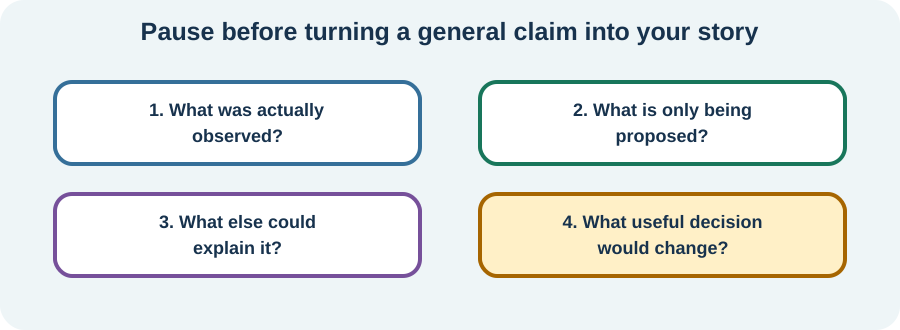
Illustration: a claim becomes more useful when evidence, uncertainty, alternatives and the decision are kept separate.
The same factor can have more than one possible role. It might increase risk, happen near the start of symptoms, contribute to a flare, make recovery harder, exist as a separate condition or have no demonstrated connection to FND. The role cannot be decided from the category alone.
Physical factors
Researchers and clinicians may consider:
- illness or infection;
- physical injury or surgery;
- migraine, pain, fatigue or poor sleep;
- medication effects or withdrawal;
- another neurological or medical condition; and
- exhaustion, activity demands, sensory surroundings or time spent upright.
A physical condition may be a possible trigger, a source of ongoing demand, a separate diagnosis, an alternative explanation for a symptom or an unrelated finding. Having FND must not prevent appropriate investigation and treatment of other conditions. [1][5][7][8]
Psychological factors
Researchers and clinicians may also consider:
- attention, expectations and past learning;
- stress, fear or persistent worry;
- trauma or other difficult experiences;
- dissociation or altered awareness; and
- anxiety, depression or another psychiatric condition.
These factors may be important for some people and not for others. Trauma, stress and mental illness are not required for an FND diagnosis. Finding one of them does not prove that it caused FND, and not finding one does not weaken a diagnosis supported by positive clinical evidence. [2][3][4]
Psychological does not mean imaginary. Thoughts, emotions, attention and learning involve real nervous-system processes, just as pain, movement and sensation do. At the same time, calling a process “brain based” does not make a proposed explanation proven. [2][3]
Social factors
Social factors can include:
- family relationships and available support;
- housing, money, work, school and caregiving demands;
- isolation or loss of meaningful roles;
- difficulty accessing knowledgeable healthcare or rehabilitation;
- harmful healthcare experiences, disbelief or stigma; and
- practical barriers such as transportation, equipment and accessibility.
These circumstances can change safety, stress, available capacity, access to care and quality of life. They are not evidence that a person caused their symptoms. Improving a social condition can be valuable even if the FND symptoms do not change. [6]
How can you judge a claim?
Be cautious when an explanation:
- says that one factor causes all FND in all people;
- treats something common in a group as proof about one individual;
- assumes that because one event happened first, it caused what came next;
- cannot be tested because every possible answer is said to prove the theory;
- calls an experimental group finding a diagnostic test or biomarker;
- says that improvement with a treatment proves the original cause;
- promises recovery if the person accepts the explanation or tries hard enough; or
- blames continuing symptoms on resistance, attention, stress or hidden trauma without individual evidence.
A stronger explanation tells you what was observed, what kind of study or clinical evidence supports it, who was studied, what remains uncertain and whether the idea changes a useful decision. It also allows for other explanations and for the theory to be wrong. [1][2][3][4][5][6]
What can this look like in ordinary life?
One person may find that migraine and poor sleep often come before a symptom flare. That pattern could help with planning without proving that either one caused the FND. Another person may benefit from trauma therapy because they want help with trauma; the benefit would not prove that trauma caused every neurological symptom. A third person may become safer after receiving mobility equipment even if their symptom frequency stays the same. [1][3][5][7]
People can also receive incompatible messages: “It is all stress,” “your nervous system is stuck in fight-or-flight,” “your brain learned the symptom,” or “one past event explains everything.” Each statement may contain an idea worth investigating, but none should be presented as a complete personal explanation without supporting evidence.
Community experiences for review
These are two candidate lived-experience quotations from the project’s community collection. One concerns physical and sensory limits; the other concerns stress, symptoms and a relationship. They are individual accounts, not proof of cause or treatment effect.
Option 1 — physical and sensory limits after treatment
“Treatment at a clinic … has helped a little, but I’m still extremely sensitive and can crash if I push past my threshold even slightly.”
— The writer described visual, sound, dizziness and sensory symptoms together. Read the public source.
Option 2 — stress and interruption in a relationship
“Sometimes I get stressed and have a seizure and our conversation sort of ends, is interrupted.”
— The writer was seeking a safer way to manage difficult conversations with a neurodivergent partner. Read the public source.
Questions
Which physical, psychological or social factors clearly affect your daily life, even if you do not know whether they affect your FND?
Have you been given an explanation that helped you understand your experience, or one that made you feel blamed or forced into someone else’s theory?
What can you safely try at home?
Choose one claim you have heard and write short answers to these questions:
- What exactly is being claimed? Is it about cause, risk, a trigger, a mechanism, treatment or day-to-day management?
- What evidence was offered? Was it about people with your symptom type, a broader group or only one person’s experience?
- What else could explain the observation? Could the relationship work in the other direction or be coincidence?
- Does it fit your experience? What supports it, and what does not?
- Would acting on it be useful and safe? Would the action still make sense if the theory were wrong?
A lower-demand version is to ask only: “Is this a fact about me, a possibility, or a general idea?”
Stop if evaluating the claim pulls you into constant symptom checking, distress or an unwanted search for memories. Seek qualified help when the claim could affect medication, medical investigation, safety or treatment. New and substantially changed symptoms need appropriate assessment rather than a theory-based assumption.
For the Person With FND
For Family, Friends, and Other Supporters
For Clinicians and the Care Team
Research and Sources
—
For Family, Friends, and Other Supporters
You do not need to solve the cause of FND in order to be helpful. Listen to the person’s understanding and uncertainty. Ask whether they want emotional support, practical help, help recording a concern or space from the subject.
Avoid interpreting ordinary emotions as the cause of symptoms, searching for trauma the person has not identified, or using a better day as proof that the problem is psychological. Do not monitor relationships, activity or stress as though you are the clinician supervising a treatment.
Practical support may include lowering a current demand, helping with access or transportation, following a safety plan, or supporting treatment that the person has chosen. Respect that an important activity may be worth a symptom or recovery cost. Social support should preserve choice rather than become another demand.
If you observe a new or substantially changed symptom, describe what you saw and help the person seek assessment. Do not decide from timing alone whether the symptom is functional, psychological or caused by another condition.
For the Person With FND
For Family, Friends, and Other Supporters
For Clinicians and the Care Team
Research and Sources
—
For Clinicians and the Care Team
Research quotations for review
These quotations are offered as two possible evidence anchors for this section. The first comes from a review proposing an integrated model; the second comes from a systematic review and meta-analysis of pain in FND.
Option 1 — Pick et al., 2019
“there is a need to integrate psychosocial (environmental) and neurobiological factors”
Option 2 — Steinruecke et al., 2024
“Pain symptoms and pain-related diagnoses are common in FND.”
Figure 1 — Research quotations offered for editorial selection. [3][5]
Build an individual formulation without turning it into a verdict
Separate the positive basis for the FND diagnosis from the formulation of possible influences. Identify whether a factor is being considered as a vulnerability, precipitant, maintaining influence, comorbidity, differential diagnosis or unrelated circumstance. State the evidence and uncertainty for that role. [1][2][3]
Migraine, epilepsy, sleep disorders, pain, medication effects, injury, psychiatric conditions and autonomic disorders can occupy different categories in different patients. Urgent alternatives, common comorbidities and problems requiring another specialist should not be compressed into one list of “FND factors.” [1][5][7][8]
Assess only what can inform care
Use history, observation and examination, targeted tests, and specialist input to answer defined questions. Do not search routinely for trauma or psychiatric illness as proof of diagnosis. Where physical, psychological or social assessment could identify treatment, safety needs or support, explain that purpose and obtain the patient’s agreement. [1][2][3]
When discussing research, name the population and outcome. Address heterogeneous samples, reverse causation, incomplete adjustment for comorbidity, replication limits and the difference between a group biomarker and an individual diagnostic test. [3][4][5][6][8]
Keep treatment and causal claims separate
Offer medical treatment, rehabilitation, psychological therapy, symptom management, environmental adaptation and social support according to the person’s needs and goals. Label whether an approach rests on direct trials, a guideline, professional consensus, specialist practice, low-risk self-management or lived experience. [1][2][6]
A beneficial treatment result does not establish cause. Do not insist on trauma work, exposure, exercise or a preferred mechanism when it is unwanted, irrelevant, ineffective or harmful. Review the plan when symptoms worsen or the formulation no longer fits. [1][2][3]
When improvement is limited, continue validation, symptom relief where possible, safety, accessibility, participation, quality of life, supporter needs and an agreed route for reassessment. A mechanism theory must never block investigation of new, severe, injured or substantially changed symptoms.
For the Person With FND
For Family, Friends, and Other Supporters
For Clinicians and the Care Team
Research and Sources
—
Research and Sources
What this evidence can and cannot establish
The diagnostic and clinical reviews support separating positive diagnostic evidence from an individual formulation. Pick and colleagues propose an integrated emotional-processing model, while the Butler survey describes a self-selected international group’s symptoms and views. The pain, prognosis, migraine and autonomic reviews show why physical, psychological and social categories should not be collapsed into one causal story: their findings concern different populations, outcomes and evidence types. Much of this literature is cross-sectional or heterogeneous, so association must not be presented as proof of direction or cause in one person. [1][2][3][4][5][6][7][8]
Citation table
| Citation | Figure | Full citation |
|---|---|---|
| [1] | — | Bennett K, Diamond C, Hoeritzauer I, Gardiner P, McWhirter L, Carson A, Stone J. A practical review of functional neurological disorder (FND) for the general physician. Clinical Medicine. 2021;21(1):28–36. FND-CIT-0001. https://doi.org/10.7861/clinmed.2020-0987 |
| [2] | — | Espay AJ, Aybek S, Carson A, et al. Current concepts in diagnosis and treatment of functional neurological disorders. JAMA Neurology. 2018;75(9):1132–1141. FND-CIT-0002. https://doi.org/10.1001/jamaneurol.2018.1264 |
| [3] | Figure 1 | Pick S, Goldstein LH, Perez DL, Nicholson TR. Emotional processing in functional neurological disorder: a review, biopsychosocial model and research agenda. Journal of Neurology, Neurosurgery & Psychiatry. 2019;90(6):704–711. FND-CIT-0005. https://doi.org/10.1136/jnnp-2018-319201 |
| [4] | — | Butler M, Shipston-Sharman O, Seynaeve M, et al. International online survey of 1048 individuals with functional neurological disorder. European Journal of Neurology. 2021;28(11):3591–3602. FND-CIT-0014. https://doi.org/10.1111/ene.15018 |
| [5] | Figure 1 | Steinruecke M, Mason I, Keen M, McWhirter L, Carson AJ, Stone J, Hoeritzauer I. Pain and functional neurological disorder: a systematic review and meta-analysis. Journal of Neurology, Neurosurgery & Psychiatry. 2024;95(9):874–885. FND-CIT-0015. https://doi.org/10.1136/jnnp-2023-332810 |
| [6] | — | Sekine ER, Kanaan RA, McMillan J, Oxford S, Iles RA. Biopsychosocial prognostic indicators in Functional Neurological Disorder: a systematic review. Journal of Psychosomatic Research. 2025;195:112201. FND-CIT-0017. https://doi.org/10.1016/j.jpsychores.2025.112201 |
| [7] | — | Stone J, Coebergh J, Khoja L, Butler M, Nicholson TR, Dodick DW. Migraine and functional neurological disorder (FND)—a review of comorbidity and potential overlap. Brain Communications. 2025;7(4):fcaf288. FND-CIT-0049. https://doi.org/10.1093/braincomms/fcaf288 |
| [8] | — | Paredes-Echeverri S, Maggio J, Bègue I, Pick S, Nicholson TR, Perez DL. Autonomic, endocrine, and inflammation profiles in functional neurological disorder: a systematic review and meta-analysis. Journal of Neuropsychiatry and Clinical Neurosciences. 2022;34(1):30–43. FND-CIT-0064. https://doi.org/10.1176/appi.neuropsych.21010025 |
This page still needs review by people with FND, supporters, clinicians and researchers, especially to check that each factor’s possible role and evidence level remain clear.
Plain-language draft prepared: September 4, 2026 · Research package added September 4, 2026 · Clinical review pending