COURSE · PART 1 · MODULE 2 · PAGE 2
Tests, Diagnostic Uncertainty, and Coexisting Conditions
Tests are important, but no test answers every question. A scan, blood test, electroencephalogram or specialist assessment is useful when it is chosen to investigate a particular possibility. This page explains why normal results do not diagnose FND on their own, why another condition can exist alongside FND, and when it may be reasonable to revisit a diagnosis.
For the Person With FND
For Family, Friends, and Other Supporters
For Clinicians and the Care Team
Research and Sources
—
For the Person With FND
A common description of the diagnostic process is, “All my tests were normal, so they said it was FND.” That explanation is incomplete. Normal test results may make some other diagnoses less likely, but they do not themselves show that a symptom is functional. The evidence for FND should come from positive features in the history, examination or nature of an event. [1][2]
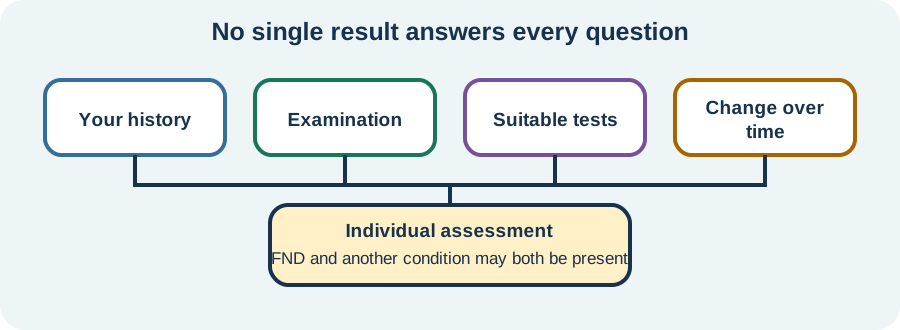
Illustration: each piece of evidence answers a limited question. No single result explains the whole illness.
Each test asks a limited question
CT and MRI scans show certain kinds of structure in the brain, spinal cord or other parts of the body. Depending on the scan and the reason it was ordered, they may help identify conditions such as a stroke, tumour, inflammation, compression or injury. A normal scan means that the particular study did not show the changes it was designed to find. It does not prove that every part of the nervous system is healthy, explain how every symptom is produced, or rule FND in.
Laboratory tests may look for infection, inflammation, nutritional problems, hormone changes, medication effects or other causes suggested by the person’s symptoms. Neurophysiology tests, such as nerve-conduction studies or electromyography, examine particular aspects of nerve and muscle function. Again, the result answers the question the test was capable of asking; it is not a verdict on the person’s entire illness.
Electroencephalography (EEG) records electrical activity from the brain using electrodes on the scalp. A routine EEG is a short sample. A normal routine EEG between episodes does not exclude epilepsy, and an abnormal EEG does not automatically explain every kind of episode a person has.
Video-EEG records behaviour and brain electrical activity together. When a person’s usual event is captured, specialists can compare what is visible with the EEG record. This can provide the highest level of diagnostic certainty for many seizure-like events. If a person has more than one kind of episode, capturing one type may not establish what the other types are. Current guidance also recommends evaluating people diagnosed with functional seizures for coexisting epilepsy. [3]
Recorded home events can sometimes help a clinician understand timing, movement, responsiveness and recovery. A recording is supporting information, not a diagnosis by itself. Safety and care come first: no one should provoke an episode, delay urgent help or place the person at risk in order to obtain a video.
More than one diagnosis can be true
Having FND does not protect a person from migraine, epilepsy, stroke, multiple sclerosis, Parkinson’s disease, a spinal problem, a sleep disorder, medication effects or other medical conditions. Sometimes another illness contributes to the same symptom; sometimes it produces a different symptom; and sometimes it may have helped trigger a functional symptom. Researchers and clinical guidance repeatedly warn against assuming that one diagnosis must explain everything. [1][3]
The term dual diagnosis is often used when FND and another neurological condition are both present. Differential diagnosis means the set of possible explanations a clinician is considering for a particular symptom. The differential for a new seizure-like event is not the same as the differential for weakness, dizziness, memory difficulty or loss of vision.
Uncertainty is not the same as disbelief
Sometimes the evidence is strong enough for a clear FND diagnosis while another question remains uncertain. At other times, the clinician may have a working diagnosis that needs more observation or testing. A useful explanation says what is known, what is suspected, what has been ruled out with reasonable confidence and what change would require another assessment.
It may be reasonable to request clarification, reassessment or another opinion when:
- no one has explained the positive evidence for the FND diagnosis;
- different clinicians have given incompatible explanations;
- the diagnosis depends only on normal tests or a history of stress;
- an episode type has not been adequately distinguished from epilepsy, syncope, migraine, a sleep event or another relevant condition;
- objective findings do not fit the current explanation; or
- a symptom is new, substantially changed, progressively worsening or accompanied by a new medical concern.
A second opinion does not automatically mean the first diagnosis was wrong. It may confirm the diagnosis, identify a coexisting condition or make the remaining uncertainty clearer.
Community experiences for review
These are two candidate lived-experience quotations from the project’s community collection. They show why reassessment and coexisting diagnoses matter; neither account tells another person what diagnosis or treatment they need.
Option 1 — another cause of light sensitivity was found
“He gave me steroid droplets … and since then my light sensitivity is gone.”
— The writer said an eye doctor found a severe pollen reaction after the symptom had been attributed to FND. This supports reassessment, not steroid treatment for functional visual symptoms. Read the public source.
Option 2 — a later binocular-vision diagnosis
“For 15 years, I was prescribed the wrong prescription glasses.”
— The writer later reported a binocular-vision diagnosis that ordinary eye examinations had not identified. Read the public source.
Questions
Which parts of your diagnosis are clear to you, and which parts still feel uncertain or unexplained?
When you think about your test results, can you separate what they ruled out from the positive evidence that supports your FND diagnosis?
What can the person safely try at home?
Make a short diagnostic record with four headings: symptom or event, positive evidence, tests and what they answered, and questions still open. This may help you and your clinicians see where the explanation is clear and where follow-up is needed.
If writing the full record is too much, begin with one sentence: “The part of my diagnosis I most need explained is…” This exercise is for organizing information. It is not a way to interpret scans, EEGs or laboratory results without a qualified clinician.
For the Person With FND
For Family, Friends, and Other Supporters
For Clinicians and the Care Team
Research and Sources
—
For Family, Friends, and Other Supporters
Diagnostic uncertainty can be exhausting. The person may be trying to understand several appointments, tests and explanations while also managing symptoms. If invited, you can help keep a simple record of what each clinician thought, what each test was meant to answer and what follow-up was promised.
For an episodic symptom, a witness description may be useful. Record what you actually observed rather than interpreting it: what happened before the event, which parts of the body moved, whether the person responded, how long the event lasted and what recovery looked like. Video may help in some cases, but only when it can be recorded without interfering with care, privacy or safety.
Try not to turn uncertainty into a dispute in which the person must choose between “FND” and “physical illness.” FND is a genuine disorder, and another neurological or medical condition may also be present. At the same time, repeated testing without a clear question can create burden without resolving the uncertainty.
Support can include helping the person prepare one or two questions, asking permission before speaking during an appointment, and making sure new or substantially changed symptoms are not automatically dismissed as familiar FND.
For the Person With FND
For Family, Friends, and Other Supporters
For Clinicians and the Care Team
Research and Sources
—
For Clinicians and the Care Team
Research quotations for review
These short quotations are placed here so a reviewer can compare possible wording from the papers before choosing what, if anything, should remain in the finished page.
Option 1 — Bennett et al., 2021
“Failure to consider comorbidity of another medical condition”
Option 2 — Espay et al., 2018
“does not depend on excluding other disorders”
Option 3 — Tolchin et al., 2026
“may obtain video-EEG of all typical seizure-like episodes where feasible.”
Figure 1 — Research quotations offered for editorial selection. [1][2][3]
How can clinicians explain testing without reducing FND to normal results? State the positive basis for the FND diagnosis separately from the purpose and result of each investigation. “The MRI did not show a stroke” and “the examination showed a positive functional sign” are different statements. Explain what was reasonably excluded, what was not tested and why further testing is or is not likely to help. [1][2]
How should investigations be selected? Begin with the actual phenotype, time course, examination and relevant red flags. Use imaging, laboratory testing, neurophysiology, EEG, video-EEG, cardiac assessment, sleep evaluation or other specialist input to answer defined questions. Avoid both indiscriminate investigation and premature closure. An incidental abnormality should not automatically be treated as causal, while a normal result should not be presented as positive evidence of FND.
For seizure-like events, obtain a detailed history and semiology from the patient and witnesses. Review available recordings when appropriate and consider video-EEG of typical event types where feasible. The meaning of a scalp EEG depends on whether a typical event was captured, the event’s suspected origin and the technical quality of the recording. Evaluate for co-occurring epilepsy and other relevant conditions rather than assuming all events share one cause. [3]
How can clinicians communicate diagnostic certainty and overlap? Distinguish a confirmed diagnosis, a probable working diagnosis and an unresolved differential. Document which positive signs support FND, which alternatives were considered, which conditions may coexist and what evidence would change the formulation. Make the explanation available to the patient and other clinicians so that every later symptom is not forced through either an “all functional” or an “all structural” interpretation.
When should the diagnosis be reviewed? Arrange reassessment for new focal findings, a materially different episode, progressive loss of previously stable abilities, injury, abnormal objective findings or a course that no longer fits the original formulation. Review is also appropriate when the original diagnosis relied only on exclusion or when the patient never received an understandable explanation of its positive basis. The goal is not endless retesting; it is a proportionate plan that protects against missed comorbidity and unnecessary investigation.
For the Person With FND
For Family, Friends, and Other Supporters
For Clinicians and the Care Team
Research and Sources
—
Research and Sources
What this evidence can and cannot establish
Bennett and Espay support a positive FND diagnosis while warning against exclusion-only reasoning and missed comorbidity. The Tolchin guideline applies specifically to functional seizures: it supports history, semiology, appropriate use of video-EEG and assessment for co-occurring epilepsy. It should not be generalized to every FND symptom or treated as a requirement that video-EEG is always possible. [1][2][3]
Citation table
| Citation | Figure | Full citation |
|---|---|---|
| [1] | Figure 1 | Bennett K, Diamond C, Hoeritzauer I, Gardiner P, McWhirter L, Carson A, Stone J. A practical review of functional neurological disorder (FND) for the general physician. Clinical Medicine. 2021;21(1):28–36. FND-CIT-0001. https://doi.org/10.7861/clinmed.2020-0987 |
| [2] | Figure 1 | Espay AJ, Aybek S, Carson A, et al. Current concepts in diagnosis and treatment of functional neurological disorders. JAMA Neurology. 2018;75(9):1132–1141. FND-CIT-0002. https://doi.org/10.1001/jamaneurol.2018.1264 |
| [3] | Figure 1 | Tolchin B, Goldstein LH, Reuber M, Stone J, Perez DL, LaFrance WC Jr, et al. Management of Functional Seizures Practice Guideline Executive Summary: Report of the AAN Guidelines Subcommittee. Neurology. 2026;106(1):e214466. FND-CIT-0010. https://doi.org/10.1212/WNL.0000000000214466 |
This page still needs review by people with FND, supporters and clinicians, including clinicians experienced in neurological diagnosis and seizure assessment.
Draft rewritten: August 24, 2026 · Research and quotation package expanded September 4, 2026 · Clinical review pending