COURSE · PART 1 · MODULE 2 · PAGE 1
Positive Signs and the Neurological Examination
FND should not be diagnosed simply because a scan was normal or because no other explanation has been found. The diagnosis should be supported by features in the history or examination that positively fit a functional neurological problem. This page explains what those features may show, as well as what they cannot show.
For the Person With FND
For Family, Friends, and Other Supporters
For Clinicians and the Care Team
Research and Sources
—
For the Person With FND
The word positive can be confusing here. It does not mean that the finding is good, nor does it mean that a blood test came back positive. A positive sign, sometimes called a rule-in sign, is something the clinician observes that gives evidence for an FND diagnosis.
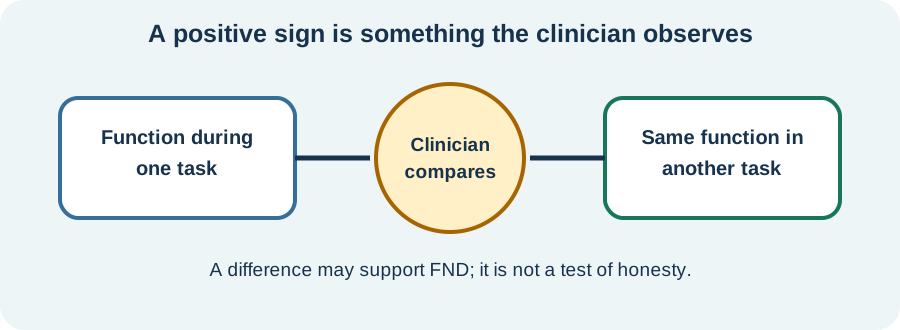
Illustration: a positive sign is an observed pattern. It is not proof that the person can choose the symptom.
The neurological examination does more than measure whether a movement is strong, weak, steady or unsteady. A clinician may compare the same movement under different conditions. They may look at what happens when you move deliberately, when another movement brings the same muscles into action automatically, when your attention is directed elsewhere, or when you copy a rhythm. The pattern across these tasks may be more informative than any one result. [1][2]
This can feel strange. A leg that will not move when you concentrate on it may move more normally during a different task. A tremor may change when the other hand follows a rhythm. Walking may be easier in one direction or with a change in timing. These changes are not evidence that the person was pretending during the more difficult task. They show that the nervous system still has access to a function under some conditions, even though the person cannot reliably bring that function under voluntary control. FND symptoms are experienced as involuntary. [1][3]
Some examples of positive signs
Hoover’s sign may be used when one leg appears weak. The clinician compares deliberate hip movement with the automatic pressure produced by that leg when the opposite leg works against resistance. Strength that is difficult to produce directly may appear during the linked automatic movement. This is evidence of preserved motor capacity, not proof that the person could simply move normally if they tried harder.
Distractibility means that a movement symptom changes when attention is drawn into another task. Entrainment is a particular tremor finding: while the person copies a rhythm with an unaffected hand or foot, the tremor may change to match that rhythm, pause or become difficult to maintain. The clinician looks for a clear and repeatable pattern, not one moment of ordinary variation.
Other FND presentations have other positive features. The examination of weakness is not used to diagnose a functional seizure, and tremor signs are not automatically applied to speech, vision, sensation or memory symptoms. There is no single bedside sign that diagnoses every form of FND.
What a positive sign does—and does not—mean
A well-supported positive sign can help explain why the clinician thinks the symptom is functional. It may also offer a starting point for rehabilitation: if movement becomes more available under one condition, treatment may explore how to make it more available in ordinary life.
However, one sign should not be separated from the rest of the history and examination. Pain, injury, fatigue, medication effects, difficulty understanding the task and other neurological conditions can affect performance. The clinician must decide whether the sign is appropriate for the symptom, whether it was demonstrated clearly, and whether another condition could also be present.
A positive sign is evidence for FND. It is not evidence that every symptom a person has is caused by FND.
The diagnosis should be explained to you. It is reasonable to ask which sign was found, to have it demonstrated when appropriate, and to ask what other possibilities were considered. New symptoms or a major change in a familiar pattern may still need assessment even after FND has been diagnosed.
Community experiences for review
These are two candidate lived-experience quotations from the project’s community collection. They illustrate individual experiences; they are not diagnostic evidence or advice that the same approach will work for everyone.
Option 1 — a competing hand task
“She handed me a rainbow coloured dodgeball and asked me to rotate it … And the tremors stopped.”
— The writer described an occupational therapist trying the task during continuous tremor. Read the public source.
Option 2 — attention moving to a question
“I’ve told people in my life to ask me a question. Sure enough … the tremor stops when I think about my answer.”
— The writer adapted a physiotherapist’s suggestion into a cue that people around them could use. Read the public source.
In both accounts, change under one condition should not be read as proof of conscious control.
Questions
Which part of the explanation for your diagnosis made the most sense to you, and which part still feels uncertain?
If a positive sign was demonstrated during your examination, how would you explain what it showed without treating it as proof that you can control the symptom?
What can the person safely try at home?
Write down the clinician’s explanation in two parts: the sign that was found and what the clinician believes it shows. If you were not given that information, write down the part that you still need your clinician to explain.
Do not repeatedly perform Hoover’s sign, tremor tests or other neurological tests on yourself. These signs require training and context to interpret. Repeatedly testing a symptom can also increase attention, worry or physical strain without making the diagnosis clearer.
For the Person With FND
For Family, Friends, and Other Supporters
For Clinicians and the Care Team
Research and Sources
—
For Family, Friends, and Other Supporters
A positive sign can be reassuring when it shows that an ability is still present under some conditions. It can also be upsetting if the explanation sounds like, “You moved once, so you must be able to move whenever you want.” That is not what the sign means. The useful message is that the symptom is genuine and involuntary, while the nervous system may still have capacity that treatment can work with.
If the person wants you at an appointment, you can help record which sign the clinician demonstrated and what was said about it. Ask the person afterward whether the explanation made sense to them. They may have heard the words but been too overwhelmed, symptomatic or uncertain to take in their meaning.
Do not test the person at home, secretly distract them to see whether a symptom changes, or use a better movement as proof that they could overcome the symptom by trying harder. This can damage trust and can turn support into surveillance. A supporter can help the person notice useful conditions for movement without taking over the role of clinician or therapist.
Continue to take new or substantially changed symptoms seriously. A previous FND diagnosis does not make every later symptom functional.
For the Person With FND
For Family, Friends, and Other Supporters
For Clinicians and the Care Team
Research and Sources
—
For Clinicians and the Care Team
Research quotations for review
These short quotations are placed here so a reviewer can compare possible wording from the papers before choosing what, if anything, should remain in the finished page.
Option 1 — Bennett et al., 2021
“The diagnosis of FND should rest on clear positive evidence”
Option 2 — Espay et al., 2018
“Positive signs are essential in supporting a phenotype-based diagnosis”
Option 3 — Hallett et al., 2022
“recognisable patterns of genuinely experienced symptoms”
Figure 1 — Research quotations offered for editorial selection. [1][2][3]
How can clinicians help the patient understand a positive sign? Name the diagnosis, identify the sign that supports it and connect the sign to the patient’s own symptom. When appropriate and with consent, demonstrate the finding rather than only describing it. Explain preserved capacity without implying conscious control: “Your leg produced stronger automatic movement during this task, even though deliberate movement remains difficult.” Avoid relying on a normal scan, a history of stress or the absence of another diagnosis as the explanation. [1][2]
How should positive signs be assessed? Use signs validated for the presenting phenotype and interpret them alongside the history, complete neurological examination and relevant differential diagnosis. Seek internal inconsistency that is reproducible and clinically meaningful, not vague fluctuation. Consider pain, neglect, comprehension, fatigue, medication, biomechanical limits and coexisting disease before attributing a finding to FND. A collection of weak or inapplicable signs should not be treated as stronger evidence merely because there are several of them.
How can the examination begin to support treatment? A respectfully demonstrated sign can do more than establish diagnosis. It can show the patient that a function is available under some conditions and help identify an initial rehabilitation strategy, such as changing attentional focus, rhythm, automatic movement or task context. The demonstration should be collaborative rather than an attempt to catch the patient out.
When should the diagnosis or examination be revisited? Reassess when the original diagnosis was never supported by a clearly described positive sign, when the observed sign does not match the symptom being diagnosed, when objective findings conflict with the formulation, or when the patient develops a new or substantially different pattern. FND and another neurological or medical condition can coexist. Continued care requires protection against both unnecessary repeated investigation and diagnostic overshadowing.
For the Person With FND
For Family, Friends, and Other Supporters
For Clinicians and the Care Team
Research and Sources
—
Research and Sources
What this evidence can and cannot establish
Bennett and Espay are clinical reviews that support an inclusionary, positive diagnosis and phenotype-appropriate signs. Hallett and colleagues provide a broader account of genuinely experienced, variable symptoms and developing shared-mechanism research. These reviews do not make every bedside observation a validated sign or allow one sign to be applied across every FND presentation. [1][2][3]
Citation table
| Citation | Figure | Full citation |
|---|---|---|
| [1] | Figure 1 | Bennett K, Diamond C, Hoeritzauer I, Gardiner P, McWhirter L, Carson A, Stone J. A practical review of functional neurological disorder (FND) for the general physician. Clinical Medicine. 2021;21(1):28–36. FND-CIT-0001. https://doi.org/10.7861/clinmed.2020-0987 |
| [2] | Figure 1 | Espay AJ, Aybek S, Carson A, et al. Current concepts in diagnosis and treatment of functional neurological disorders. JAMA Neurology. 2018;75(9):1132–1141. FND-CIT-0002. https://doi.org/10.1001/jamaneurol.2018.1264 |
| [3] | Figure 1 | Hallett M, Aybek S, Dworetzky BA, McWhirter L, Staab JP, Stone J. Functional neurological disorder: new subtypes and shared mechanisms. The Lancet Neurology. 2022;21(6):537–550. FND-CIT-0003. https://doi.org/10.1016/S1474-4422(21)00422-1 |
This page still needs review by people with FND, supporters and clinicians, including a clinician experienced in neurological diagnosis.
Draft rewritten: August 24, 2026 · Research and quotation package expanded September 4, 2026 · Clinical review pending