COURSE · PART 3 · MODULE 10 · PAGE 1
Attention, Memory, Word Finding, and Functional Cognitive Disorder
Losing a word, a plan or part of a conversation can feel frightening. The difficulty is real even when a scan is normal or a formal test shows an uneven pattern.
For the Person With FND
For Family, Friends, and Other Supporters
For Clinicians and the Care Team
Research and Sources
—
For the Person With FND
Definition
Cognition includes attention, processing speed, working memory, remembering, language, recognition, mental imagery and executive functions such as planning and restarting. Functional Cognitive Disorder (FCD) means distressing or disabling cognitive symptoms with positive signs that the difficulty is functional and not better explained by another condition.
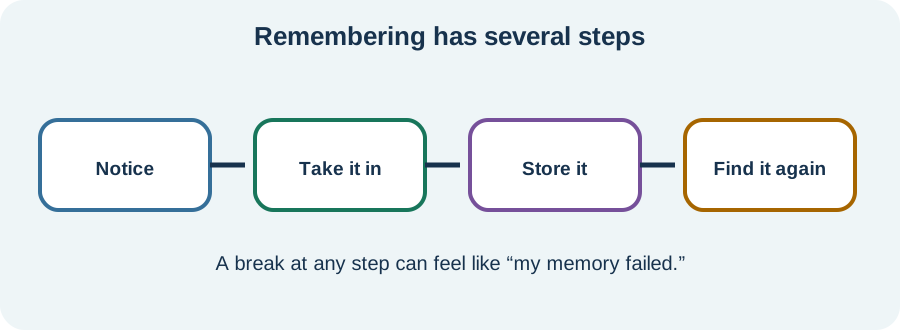
Illustration: memory is a path, not one box. Trouble at an earlier step can feel like lost storage.
If you read only one thing
FCD is not “imagined memory loss,” and it is not the name for every thinking problem in FND. A clinician should look for features supporting the diagnosis and check for other contributors. [1][2]
Different processes need different help
Encoding means taking information in well enough to form a usable memory. Working memory holds and uses it briefly; consolidation helps stabilize learning; retrieval brings it back later. A lapse at different stages can feel like forgetting. This does not mean all information was stored intact. [1][2]
Recognizing a face while seeing it differs from knowing who the person is, finding their name, recalling their appearance later or voluntarily picturing them. Semantic knowledge includes facts about people and things, not only words. Visual recall, spatial abilities and imagery deserve separate description when affected.
A new loss of imagery, including imagery that used to be unusually vivid, deserves assessment. Face-recognition or imagery complaints are not established hallmark FCD findings. The full FCD background page explains the distinctions and evidence limits; they are not additional diagnostic signs. [5]
One everyday example
Imagine being told three instructions while a television is on and pain is flaring. If attention catches only the first instruction, the other two may never be stored. Later, this feels like forgetting.
Word finding can work similarly: you know the person or object, but the word does not arrive when needed. Thinking speed, working memory and planning may also become overloaded.
What “internal inconsistency” means
In FCD research, internal inconsistency means a person’s cognitive ability is available at some times or in some tasks but becomes hard to access in others. The comparison must concern the same domain and account for demands, cues, fatigue and other explanations. One good performance does not establish the diagnosis or cancel disability. It is not proof of pretending. It can appear in the history, conversation or testing and must be interpreted carefully.
Some people with FCD have persistent disability. Others improve. A normal score on one test does not describe the demands of a whole day. [1][2]
Working models are not settled causes
Competing load can leave less attention for encoding or holding information in working memory. After real failures, monitoring and predictions about the next failure may add further demands in some people. Metacognition means judging and responding to your own thinking. Monitoring work can help when an unhelpful loop is present; it is not an explanation for everybody’s symptoms. Predictions can also reflect real limitations.
A trigger at onset, a process causing today’s lapse and a factor keeping difficulties going are different questions. Improvement with an aid or therapy does not answer all of them or prove a psychological cause. See working models and their limits. [1][2][3]
Other causes still matter
Poor sleep, migraine, pain, fatigue, medication or substance effects, depression, anxiety, seizures, head injury, nutritional or hormone problems and neurological disease can all affect cognition. More than one can be present. Migraine, pain, fatigue, sleep disorders, ADHD and sensory impairment may independently affect cognition or coexist with FCD; they are not automatically part of that diagnosis.
New loss of recognition of highly familiar people, familiar knowledge or spatial abilities also deserves reassessment. Seek prompt assessment for a sudden new confusion, new neurological signs, getting lost in familiar places, a major safety error, a changed seizure pattern, decline after a head injury, or rapid or progressive worsening.
Community experiences for review
These are lived experiences, not evidence that one approach will work for everyone.
Option 1 — improvement with tailored support
“I worked tirelessly with a speech therapist … and regained a lot of cognition.”
— The writer also said traditional methods could worsen their FND and valued FND-informed pacing cues. Read the public source.
Option 2 — familiar work became difficult
“Simple tasks I’ve done at work for years now demand major concentration … I’ve been making many mistakes in my work.”
— The writer described the effect on a business run with their husband. Read the public source.
Supported participation counts: a written cue, extra time or contextual help can be part of recovery. Useful aids need not be removed to demonstrate improvement. [3]
Questions
Which thinking difficulty most changes your day: taking information in, holding it briefly, finding it later, using words or planning steps?
When does that ability become easier to access, even a little?
One small thing you can do
For one task today, remove one competing demand: mute the television, sit down, or ask for one instruction at a time. A lower-demand version is simply to notice which competing demand was present.
Stop if the experiment increases distress or makes a task unsafe. Ask for clinical or occupational support when cognitive problems affect medication, cooking, driving, money, work or personal safety.
For the Person With FND
For Family, Friends, and Other Supporters
For Clinicians and the Care Team
Research and Sources
—
For Family, Friends, and Other Supporters
Give one subject at a time and allow extra processing time. Offer a cue or written note instead of testing the person: “The appointment is at two” is usually kinder and more useful than “Don’t you remember?”
Do not assume that an inconsistent ability is voluntary. Also do not take over every decision. Ask which tasks need backup and which the person wants to keep doing independently.
For the Person With FND
For Family, Friends, and Other Supporters
For Clinicians and the Care Team
Research and Sources
—
For Clinicians and the Care Team
Research quotations for review
Option 1 — Ball et al., 2020
“the chief clinical indicator of which is internal inconsistency”
Option 2 — McWhirter et al., 2022
“Identifying functional cognitive disorder”
Figure 1 — Research quotations offered for editorial selection. [1][2]
Make a positive but proportionate assessment
Characterize attention, processing speed, working memory, prospective memory, episodic encoding and retrieval, semantic access and executive function, with recognition/familiarity, visual or nonverbal memory, visuospatial function, imagery and cognitive communication when relevant. Look for positive internal inconsistency across history, observation and testing; do not infer FCD from distress, normal imaging or an invalid score alone.
Review onset, course, functional impact, medication and substances, sleep, pain, migraine, mood, epilepsy, head injury and systemic contributors. Neuropsychological assessment may clarify a profile and practical needs, but test performance has imperfect ecological validity. Discuss validity measures without accusation.
Treat contributing conditions and reduce cognitive load. Consider occupational therapy, speech-language therapy, neuropsychology or other rehabilitation for external aids and metacognitive strategies. Evidence for FCD-specific interventions remains preliminary. [1][2][3][4]
For the Person With FND
For Family, Friends, and Other Supporters
For Clinicians and the Care Team
Research and Sources
—
Recovery reading: Thirteen detailed Functional Cognitive Disorder recovery pages, with practical support, individual safety limits and clear distinctions between clinical guidance and early research.
Research and Sources
The FCD sources offer a proposed diagnostic model and preliminary definition rather than a universally decisive test. The online intervention trial was a small feasibility study, not proof of effectiveness. [1][2][3][4]
Related reference pages: FCD diagnostic signs · FCD recovery ideas
| Citation | Figure | Full citation |
|---|---|---|
| [1] | Figure 1 | Ball HA, McWhirter L, Ballard C, et al. Functional cognitive disorder: dementia’s blind spot. Brain. 2020;143(10):2895–2903. FND-CIT-0071. https://doi.org/10.1093/brain/awaa224 |
| [2] | Figure 1 | McWhirter L, Ritchie C, Stone J, Carson A. Identifying functional cognitive disorder: a proposed diagnostic risk model. CNS Spectrums. 2022;27(6):754–763. FND-CIT-0026. https://doi.org/10.1017/S1092852921000845 |
| [3] | — | Nicholson C, Edwards MJ, Carson AJ, et al. Occupational therapy consensus recommendations for functional neurological disorder. Journal of Neurology, Neurosurgery & Psychiatry. 2020;91(10):1037–1045. FND-CIT-0011. https://doi.org/10.1136/jnnp-2019-322281 |
| [4] | — | Poole N, Cope S, Vanzan S, et al. Randomised controlled feasibility trial of online group acceptance and commitment therapy for functional cognitive disorder. BJPsych Open. 2025;11(3):e91. FND-CIT-0036. https://doi.org/10.1192/bjo.2025.33 |
| [5] | — | Zeman AZJ, Della Sala S, Torrens LA, et al. Loss of imagery phenomenology with intact visuo-spatial task performance: a case of “blind imagination”. Neuropsychologia. 2010;48(1):145–155. DOI. FND-CIT-0191. Single acquired-imagery case, not FCD prevalence or treatment evidence; imagery experience and task performance may differ. |
This page still needs review by people with cognitive symptoms, neuropsychologists, occupational therapists, neurologists and accessibility reviewers.
Plain-language draft and research package prepared: September 5, 2026 · Clinical review pending