COURSE · PART 1 · MODULE 1 · PAGE 3
Remission, Recovery, and What Improvement Can Mean
> **"FND symptoms may recur or worsen regardless of what a person knows, tries, or has achieved. Symptom severity must never be used to judge effort, acceptance of the diagnosis, treatment participation, or personal progress."**
Course principle
This is a short introduction. Later modules will discuss treatment, rehabilitation, setbacks and long-term management in much more detail. Here, we only need enough information to understand what people may mean when they talk about getting better.
For the Person With FND
For Family, Friends, and Other Supporters
For Clinicians and the Care Team
Research and Sources
—
For the Person With FND
One of the big questions, once, perhaps the shock of diagnosis fades, is “Can this go away?” Maybe instead of ‘go away’ words like remission, cure, or recovery might replace them. If we are talking about a cure, meaning, the disease functional neurological disorder is no longer present nor will ever come back, then as far as anyone currently knows, no. There is no cure. However, people do experience recovery or remission. Because the two words can be used to mean the same thing, let’s give them definitions that this course will use.
For this course, ‘remission’ refers to all or some of a person’s symptoms disappearing for a time. Some have experienced remission for years - the likeliness often depending on a few factors especially what symptoms were disrupting their lives. [1][2][5][6]
Recovery has a few meanings. For instance, I might say, ‘After a functional seizure I need a few days of recovery.’ In that sense, recovery means bringing myself into a more stable state, where my symptoms are less triggered and that my energy or ability to cope returns. [2][3]
Recovery does not have to mean that every symptom has disappeared.
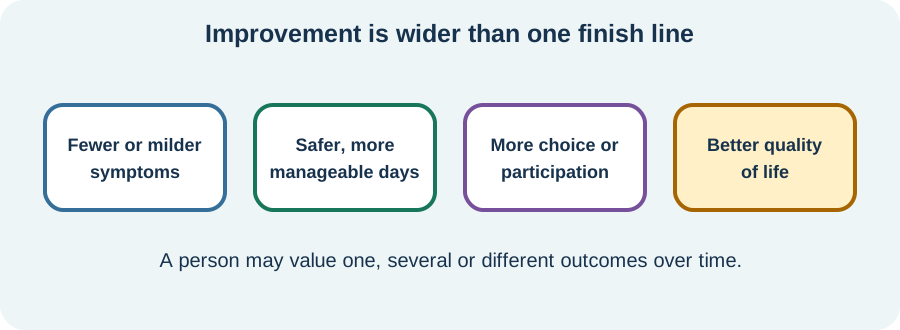
Illustration: improvement can take more than one form. A person may value different outcomes at different times.
A key thing to take away in this section is that FND symptoms can grow worse or go away for a time. [1][2][5] A return of symptoms does not mean failure; it’s just the progress of the disease.
Questions
If one part of your health or daily life improved, which change would matter most to you?
What would recovery mean to you if some symptoms remained?
What can you safely try at home?
Choose one small sign of improvement that would matter in your life. It might be a symptom change, but it could also be recovering more quickly after an episode, preparing part of a meal, enjoying time with someone, asking for help more clearly, or doing an activity with less fear. Write down one sentence if it’s useful. [3]
Crosswords
- Recovery (normal) (easy) (answer key)
For the Person With FND
For Family, Friends, and Other Supporters
For Clinicians and the Care Team
Research and Sources
—
For Family, Friends, and Other Supporters
Thank you for supporting someone’s recovery process. It’s important for both you and the sufferer to have a clear goal in mind with steps along the way of what recovery looks like. When a person has many symptoms at once, what recovery looks like can range from adapting to their most disabling symptom to just getting stable after the trauma of diagnosis. [2][3]
What is important to many sufferers of FND is holding some independence, comfort, feeling safe, and keeping or gaining relationships. [2][3] In fact, making life safer and more accessible may do a lot to lower the intensity of their symptoms. It’s also important to help them access mobility equipment.
When functional neurological disorder was less understood, it was felt that providing mobility aids could *“prevent the return of normal movement”. Recently, the guidance is that mobility aids are “reasonable and appropriate” when they improve safety, independence, and access to the community.
Figure 1
If symptoms return or don’t respond to a treatment, help the person notice what they have learned and what still works. Recovery may include becoming better prepared for difficult periods, adapting, and it can’t be about preventing every symptom. [2][3]
For the Person With FND
For Family, Friends, and Other Supporters
For Clinicians and the Care Team
Research and Sources
—
For Clinicians and the Care Team
You are an essential part of recovery. The question is, what does recovery look like for your patient? Let’s define key terms. Symptom Remission. Some or all of the patient’s symptoms are absent for a period of time.
Symptom Improvement. This refers to symptoms becoming less frequent, severe or prolonged.
Functional Improvement. The person can do more, participate more or be more independent despite continuing symptoms.
Personal Recovery. Rather than be about their symptoms, recovery speaks more to their quality of life; their personal confidence, their relationships and purpose or identity and safety.
Recovery after an episode. This is the shorter process (hours to days, sometimes longer) of returning to the person’s usual level after flare of symptoms or a functional seizure. [2][3]
Although many of these outcomes overlap, they are not interchangeable. Research supports making the patient’s experience central while also considering symptoms, daily activities, mental health and quality of life. [3]
A useful prognosis conversation sounds like:
“Improvement is possible, but we can’t predict exactly how much, how quickly, or how permanently you’ll improve. Some people experience complete or long-lasting remission. Others improve partly, fluctuate, or continue to need substantial support.” And at a later time, perhaps, “Let’s decide what improvement would look like for you and review it together.” [1][5][6]
This avoids two damaging extremes:
- “You will recover if you accept the diagnosis and work hard.”
- “You have had this too long, so nothing will help.”
A psychologist reviewing my case in behalf of an insurer wrote, “The longer conversion symptoms are present, the worse the prognosis” Later, a neuropsychiatrist assigned to assess how FND had affected me wrote, “Functional barriers …, in combination with poor prognosis owing to the duration of symptoms (and) history of trauma.
— (Lived experience)
Clinicians should explain the intent of a particular referral. On this site, there is a reference guide on treatments for specific symptoms, our reference page contains a complete index of techniques. These can help to determine which treatment may be best. [7]
Recovery is not one binary verdict. The clinician’s responsibility is to define outcomes with the patient, communicate uncertainty honestly, match care to what matters, and continue helping even when symptoms persist.
For the Person With FND
For Family, Friends, and Other Supporters
For Clinicians and the Care Team
Research and Sources
—
Research and Sources
Three focused quotations
- “Reported symptom outcome was highly variable.” [1]
- “recovery often follows a pattern of symptom remission and exacerbation.” [2]
- “all believed that the patient’s subjective experience should be central.” [3]
Citation table
| Citation | Figure | Full citation |
|---|---|---|
| [1] | — | Gelauff J, Stone J, Edwards M, Carson A. The prognosis of functional (psychogenic) motor symptoms: a systematic review. Journal of Neurology, Neurosurgery & Psychiatry. 2014;85(2):220–226. FND-CIT-0007. https://doi.org/10.1136/jnnp-2013-305321 |
| [2] | Figure 1 | Nicholson C, Edwards MJ, Carson AJ, et al. Occupational therapy consensus recommendations for functional neurological disorder. Journal of Neurology, Neurosurgery & Psychiatry. 2020;91(10):1037–1045. FND-CIT-0011. https://doi.org/10.1136/jnnp-2019-322281 |
| [3] | — | Rutten S, Bradley-Westguard A, Nicholson TR, et al. Outcome measurement in functional neurological disorder: a qualitative study on the views of patients, caregivers and healthcare professionals. Journal of Neurology. 2025;272:189. FND-CIT-0012. https://doi.org/10.1007/s00415-025-12912-9 |
| [4] | Figure 1 | Nielsen G, Stone J, Matthews A, et al. Physiotherapy for functional motor disorders: a consensus recommendation. Journal of Neurology, Neurosurgery & Psychiatry. 2015;86(10):1113–1119. FND-CIT-0028. https://doi.org/10.1136/jnnp-2014-309255 |
| [5] | — | Sekine ER, Kanaan RA, McMillan J, Oxford S, Iles RA. Biopsychosocial prognostic indicators in Functional Neurological Disorder: a systematic review. Journal of Psychosomatic Research. 2025;195:112201. FND-CIT-0017. https://doi.org/10.1016/j.jpsychores.2025.112201 |
| [6] | — | Thomas ST, Thomas ET, Schembri E, Lehn AC, Palmer DDG. Treatment outcomes in functional neurological disorder: a systematic review and meta-analysis exploring the influence of symptom chronicity. BMJ Neurology Open. 2025;7:e001150. FND-CIT-0051. https://doi.org/10.1136/bmjno-2025-001150 |
| [7] | — | Dworetzky BA, Baslet G. Functional neurological disorder: Practical management. Neurotherapeutics. 2025;22(4):e00612. FND-CIT-0013. https://doi.org/10.1016/j.neurot.2025.e00612 |
This page is a brief introduction. Detailed discussion of rehabilitation, pacing, psychological treatment, setbacks and progress belongs in the later course modules.