COURSE · PART 6 · MODULE 21 · PAGE 3
Recover, Review, and Update the Plan
A later review can make the next setback less confusing. It should not become an investigation into what you did wrong.
For the Person With FND
For Family, Friends, and Other Supporters
For Clinicians and the Care Team
Research and Sources
—
For the Person With FND
Definition
A setback review is a short look back after you are more stable. Its purpose is to keep, change or remove parts of the plan—not to prove one cause.
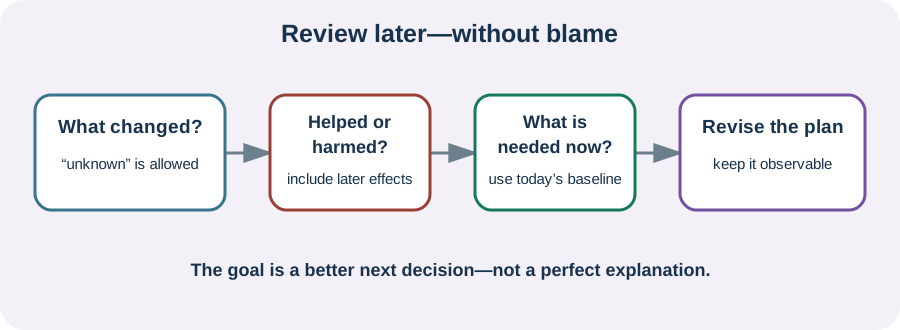
Illustration: look at what changed and what helped or harmed, then update the plan for present needs.
If you read only one thing
You do not need a perfect explanation. Record only what could change a future decision. Recovery may mean returning to an earlier level, finding a new baseline, improving one part of life or making life safer while symptoms persist.
Review without blame
Ask:
- What was different? Include illness, injury, medication, sleep, pain, activity, sensory or social load—but leave “unknown” available.
- What helped, did nothing or caused harm? Include the later effect, not only what happened during the activity.
- What changed in daily life? Note support, aids, communication, work, care tasks and recovery time.
- What should the plan say next time? Keep the answer short and observable.
Worsening, recurrence, slow recovery or a changed baseline does not measure effort. FND has no cure. Treatment may improve symptoms, function or quality of life for some people, but a person who remains disabled has not failed.
Do not rush back to a previous schedule because the calendar says enough time has passed. Re-enter activities in a way that fits current safety, capacity, goals and other health conditions. Research measures are limited, and group results cannot predict your outcome. [1][2][3]
Community experiences for review
Option 1 — quality of life without a cure claim
“Therapy will not cure FND. Therapy can massively improve the quality of life for people like us.”
— One person’s view; the kind and degree of benefit vary. Read the public source.
Option 2 — harm from promised cure and blame
“I do mind the near guarantee of a cure and when it doesn’t work they blame you.”
— One person’s response to “retraining” language. Read the public source.
Questions
After your last difficult period, what did you learn that could make the next one safer or kinder?
Which expectation about “getting back to normal” is helping you, and which one is adding pressure?
One small thing you can do
Complete one sentence: “Next time, keep ___ and change ___.” “I do not know yet” is a valid answer. If the setback involved injury, a new pattern or treatment harm, review it with an appropriate clinician.
For the Person With FND
For Family, Friends, and Other Supporters
For Clinicians and the Care Team
Research and Sources
—
For Family, Friends, and Other Supporters
Wait until the person has enough capacity, then ask whether they want to review together. Offer observations as observations: “I noticed recovery took longer,” not “You caused this by…”
Review your role too. What help was wanted? What was unsustainable, unsafe or outside your role? A better plan can protect both people without making the supporter a monitor or clinician.
For the Person With FND
For Family, Friends, and Other Supporters
For Clinicians and the Care Team
Research and Sources
—
For Clinicians and the Care Team
Research quotations for review
Option 1 — Pick et al., 2020
“few well-validated FND-specific outcome measures”
Option 2 — Thomas et al., 2025
“did not negate meaningful gains”
Figure 1 — Research quotations offered for editorial selection. [2][3]
Use the setback as information, not a verdict
Review current semiology, function, comorbidity, adverse effects, barriers, accessibility and the patient’s priorities. Separate a plausible contributor from a proven cause. Decide together whether to resume, reduce, adapt, stop or reassess an intervention.
Use several outcome domains and record non-response or harm. Chronicity may be associated with some group-level differences, but it does not determine an individual’s potential or entitlement to care. Continue symptom relief, safety, access, participation and review even when restoration is limited. [1][2][3]
For the Person With FND
For Family, Friends, and Other Supporters
For Clinicians and the Care Team
Research and Sources
—
Research and Sources
These sources support flexible goals and broader outcome review. The treatment meta-analysis describes group averages and cannot predict one person’s course. [1][2][3]
| Citation | Figure | Full citation |
|---|---|---|
| [1] | — | Nicholson C, Edwards MJ, Carson AJ, et al. Occupational therapy consensus recommendations for functional neurological disorder. Journal of Neurology, Neurosurgery & Psychiatry. 2020;91(10):1037–1045. FND-CIT-0011. https://doi.org/10.1136/jnnp-2019-322281 |
| [2] | Figure 1 | Pick S, Anderson DG, Asadi-Pooya AA, et al. Outcome measurement in functional neurological disorder: a systematic review and recommendations. Journal of Neurology, Neurosurgery & Psychiatry. 2020;91(6):638–649. FND-CIT-0067. https://doi.org/10.1136/jnnp-2019-322180 |
| [3] | Figure 1 | Thomas ST, Thomas ET, Schembri E, Lehn AC, Palmer DDG. Treatment outcomes in functional neurological disorder: a systematic review and meta-analysis exploring the influence of symptom chronicity. BMJ Neurology Open. 2025;7(2):e001150. FND-CIT-0051. https://doi.org/10.1136/bmjno-2025-001150 |
This page still needs review by people with persistent or recurrent FND, supporters and clinicians who provide long-term care.
Plain-language draft and research package prepared: September 9, 2026 · Clinical review pending