COURSE · PART 5 · MODULE 20 · PAGE 1
Work, School, and Accommodations
The same job or class can contain many demands: travel, standing, screens, noise, memory, speed, attendance, safety and recovery afterward.
For the Person With FND
For Family, Friends, and Other Supporters
For Clinicians and the Care Team
Research and Sources
—
For the Person With FND
Definition
An accommodation is a change to a task, schedule, setting or way of communicating that reduces a disability-related barrier. Whether a change is legally required depends on the local law and setting.
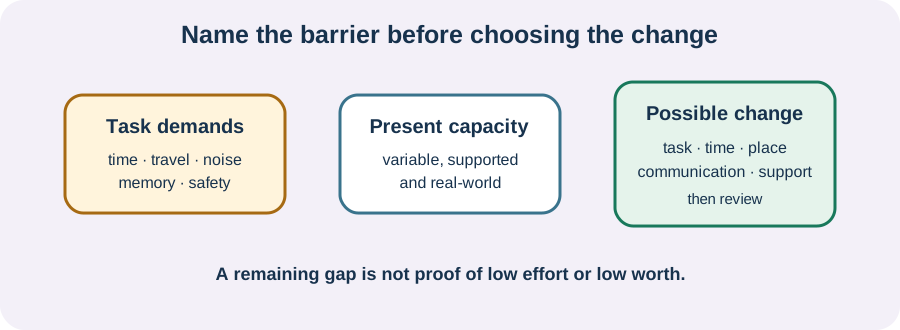
Illustration: the gap is information about the task and setting. It is not a measure of intelligence, effort or worth.
If you read only one thing
An accommodation may make work or study possible. If it does not, inability to continue is not personal failure. FND has no cure, and rehabilitation does not guarantee that someone can work.
Name the barrier before the solution
Examples include flexible start time, predictable breaks, remote attendance, fewer simultaneous tasks, written instructions, reduced noise or light, an accessible route, seating, a communication method or adjusted attendance. A useful request connects the change to a function: “Because processing slows during episodes, I need written instructions and one task at a time.”
Sometimes no reasonable change makes the role safe, reliable or sustainable. Sick leave, reduced study, role change or stopping may be necessary. Rules for accommodations, disability status and benefits differ by jurisdiction; seek local advice rather than relying on this course as legal guidance.
Research shows work difficulty in selected FND groups, but it cannot predict an individual’s capacity. One survey concerned self-selected people with functional seizures; a 2026 disability study came from one Australian tertiary clinic. A separate two-centre study found that participants often anticipated stigma at work, but it does not show that every workplace will respond badly. [1][2][3]
Community experiences for review
Option 1 — familiar tasks becoming difficult
“Simple tasks I’ve done at work for years now demand major concentration … I’ve been making many mistakes in my work.”
— One person’s account of cognitive symptoms at work. Read the public source.
Option 2 — reduced hours can still overwhelm
“I have gone from full-time hours … to about 8 hours per week, and even this can be overwhelming and exhausting.”
— One person’s account of trying to remain employed. Read the public source.
Questions
Which hidden demand of work or school costs you the most before or afterward?
What would you want others to understand if an accommodation still did not make attendance possible?
One small thing you can do
Choose one task and finish: “The barrier is ____; a change that might help is ____.” If safety-critical work, driving, machinery, heights, water, lone work or episodes are involved, seek individualized occupational and medical advice.
For the Person With FND
For Family, Friends, and Other Supporters
For Clinicians and the Care Team
Research and Sources
—
A response plan for motor or vocal tics
Discuss options with the person rather than prescribing the same accommodations to everyone. A private break space, an alternative presentation or communication route, safer equipment and one agreed contact may be useful. Record how others should respond to involuntary words, and protect the person from punishment or demanded suppression. Include what to do for injury or a changed event. Diagnosis · Recovery and care.
For Family, Friends, and Other Supporters
Do not use paid work as proof that the person is well, or unemployment as proof they have stopped trying. Help with one concrete task—forms, transport, a meeting note—if asked. Respect the person’s decision about disclosure; employers or educators do not automatically need every medical detail.
For the Person With FND
For Family, Friends, and Other Supporters
For Clinicians and the Care Team
Research and Sources
—
For Clinicians and the Care Team
Research quotations for review
Option 1 — Woodward et al., 2023
“work difficulties are common”
Option 2 — Mcloughlin et al., 2026
“Anticipated stigma was experienced most from work”
Figure 1 — Research quotations offered for editorial selection. [1][3]
Describe demands and function
Ask about the actual tasks, commute, schedule, cognitive and sensory load, safety, variability, recovery time and coexisting conditions. Separate capacity for a brief clinic task from reliable performance over a week. Document restrictions and possible changes without promising an employment result.
The functional-seizure survey was self-selected and cannot prescribe universal restrictions. The tertiary-clinic study shows substantial disability in a selected group, not that all people with FND cannot work. Support graded return when chosen and safe; also support leave, benefits and ongoing care when work is not possible. Employment is not a recovery outcome that overrides health, access or the person’s priorities. [1][2][3]
For the Person With FND
For Family, Friends, and Other Supporters
For Clinicians and the Care Team
Research and Sources
—
Research and Sources
Source and limits: Malaty IA, Anderson S, Bennett SM, et al. Diagnosis and management of functional tic-like phenomena. Journal of Clinical Medicine. 2022;11(21):6470. Source. FND-CIT-0110; expert guidance, not a trial of these accommodations.
| Citation | Figure | Full citation |
|---|---|---|
| [1] | Figure 1 | Woodward J, Guler S, Balcer LJ, et al. Work difficulties, work restrictions, and disability benefits in people with functional seizures: a survey study. Epilepsy & Behavior Reports. 2023;23:100610. FND-CIT-0084. https://doi.org/10.1016/j.ebr.2023.100610 |
| [2] | — | Moss RSL, Lennon MJ, Anne S, et al. Disability, distress and delayed access to care in functional neurological disorder: cross-sectional study from an Australian tertiary clinic. BJPsych Open. 2026;12(3):e128. FND-CIT-0090. https://doi.org/10.1192/bjo.2026.11038 |
| [3] | Figure 1 | Mcloughlin C, Ludwig L, Carson A, Stone J. Stigma in functional neurological disorder: a longitudinal study. Journal of Psychosomatic Research. 2026;203:112550. FND-CIT-0089. https://doi.org/10.1016/j.jpsychores.2026.112550 |
This page still needs review by workers, students, people unable to work, occupational-health clinicians, educators and legal reviewers from multiple jurisdictions.
Plain-language draft and research package prepared: September 8, 2026 · Clinical review pending